The Floor
GelSlim 5.0 Cuts Tactile Depth Error 61.2% With One Camera
GelSlim 5.0 uses one camera and switched UV illumination to collect visual and tactile images from a shared viewpoint. In tests on 12 known objects, paired inputs reduced depth mean squared error by 61.2% compared with tactile-only inference.
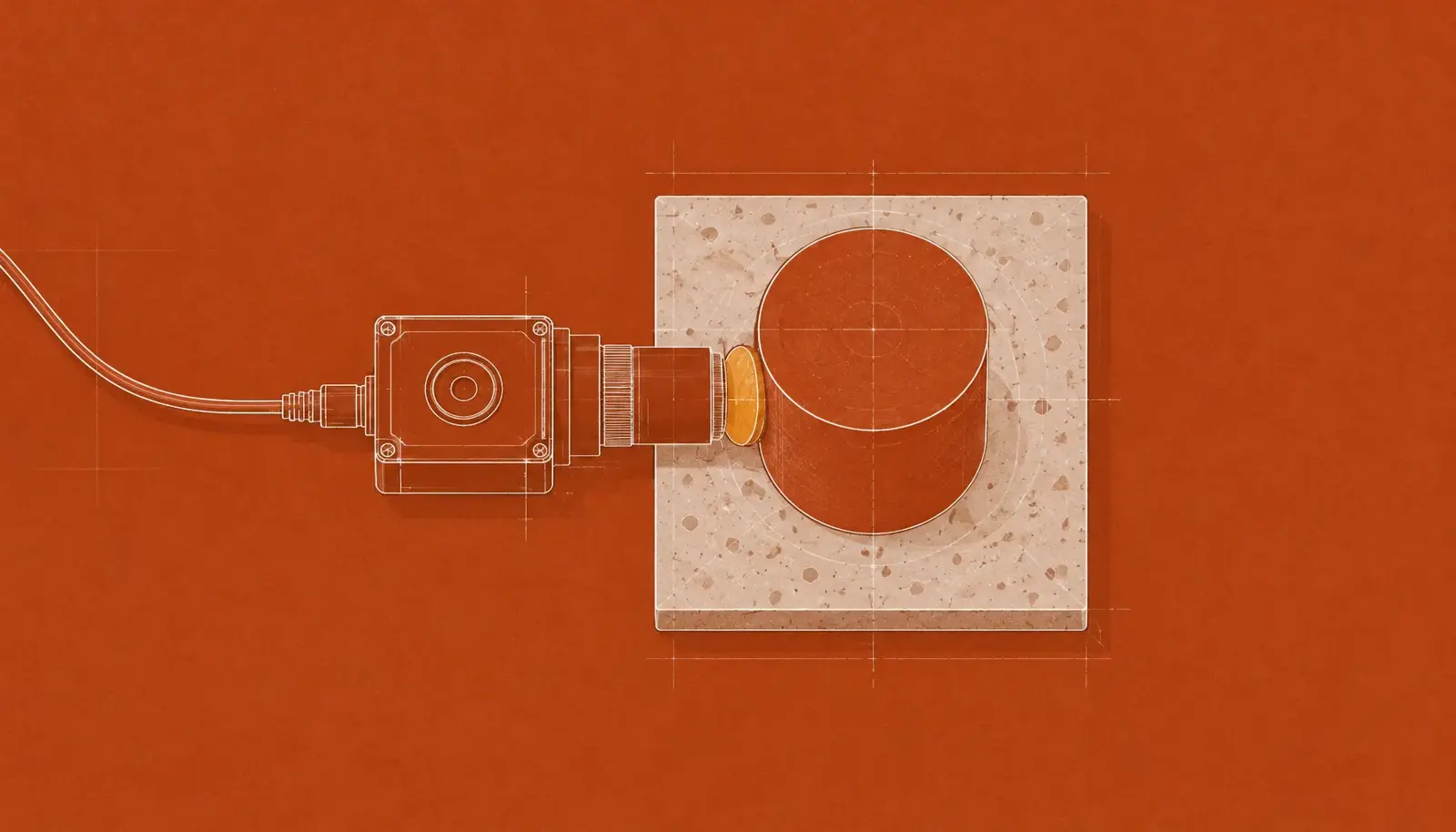
Pairing vision and touch cut contact-depth mean squared error by 61.2% in tests of GelSlim 5.0, a fingertip sensor that uses one camera for both kinds of image. The result, measured against touch-only inference on 12 known objects, comes from a University of Michigan research team’s paper submitted to arXiv on October 22, 2026. The sensor switches UV illumination to change what its camera records, giving the system a shared viewpoint for object appearance and contact.
One camera, two illumination states
With UV illumination off, the camera captures a visual image through the sensor’s membrane. With UV on, it records an image sensitive to contact. The observations arrive sequentially, not simultaneously, and the authors collect them under approximately stationary contact.
That shared camera removes the need to calibrate the relative positions of separate vision and touch cameras. It does not eliminate other calibration needs: the authors say camera intrinsics and object-pose calibration still matter, while refraction, membrane deformation and residual motion can affect pixel alignment. The prototype uses a Raspberry Pi camera, a custom driver board and a continuous UV-responsive contact layer inside a body based on GelSlim 4.0.
VisTacFusion keeps touch detail in the estimate
The team pairs the sensor with VisTacFusion, a multimodal transformer that separates planar object-pose estimation from contact-geometry estimation. Its pose pathway uses tactile features and visual context; a separate pathway keeps spatial tactile features for predicting contact depth and surface normals. Modality dropout trains the model to work with the paired images or with either image stream alone.
On the real validation set, paired inputs lowered depth MSE by 61.2%, angular error by 72.3% and translation error by 61.3% compared with touch-only inference using the same model. Against vision-only inference, the reductions were 93.7% for depth MSE, 6.1% for angular error and 8.6% for translation error. The paper’s authors—Xiangdong Wang, I-Hsuan Huang, Xiaohao Xu, Xili Yi, Nima Fazeli and Xiaonan Huang—write:
Xiangdong Wang, I-Hsuan Huang, Xiaohao Xu, Xili Yi, Nima Fazeli and Xiaonan Huang, GelSlim 5.0: Unifying Vision and Touch with a Single Fingertip CameraWithin-session validation shows lower contact-depth and pose errors for paired observations than for either input alone in the same estimator.
The test covers known objects, not new tasks
The evaluation draws on about 400 contacts for each of 12 objects, with a KUKA LBR Med R820 arm recording images and end-effector pose. Validation samples come from the same objects and acquisition sessions as training, and the model receives object identity for pose estimation. The scores therefore describe within-session performance on known objects, not generalization to unfamiliar objects or later sessions.
The geometry targets also have a defined source: the researchers calculate depth maps from object geometry and pose, then derive surface normals from those maps. Those are computed references, not independent measurements of the deformed membrane. The paper says future evaluations will test cross-session generalization and compare predicted contact geometry with direct measurements of membrane shape.
A prototype still needs smaller packaging
GelSlim 5.0 retains the GelSlim 4.0 body rather than demonstrating a miniature fingertip package. The authors identify camera, lens, lighting, electronics and contact-layer redesign as work needed to reduce size and power use. They also plan to measure energy per paired observation and contact-surface temperature.
The paper reports a durability test in which a spherical indenter applied more than 45,000 normal indentations at 20 newtons without observed cracking, delamination or loss of the imaging-state change. That result covers normal loading; the authors did not quantify sliding wear, contamination or optical drift. For now, the clearest limits are in the evaluation: 12 known objects, within-session validation and observations captured in sequence under nearly still contact.
Sources
- Original source · Preprint GelSlim 5.0: Unifying Vision and Touch with a Single Fingertip Camera arXiv:2610.31334
Related stories
- KAIST team builds flexible display for human and robot vision
- TouchTwin uses tactile recordings to build simulated hand demonstrations
- CoRA-VTLA preprint adds tactile memory to robot manipulation
- SPICE policy reaches through foliage using tactile feedback
- TacPilot paper reports 56.4% fewer tactile regions encoded