The Floor
Industrial Next Pitches Factory Robot Task Changes in Minutes
Industrial Next’s AI-powered robotic stations can take on new factory tasks in minutes instead of weeks, the startup says. At TechCrunch Disrupt on October 13, the startup also announced that BMW Group Technology Office will evaluate its dexterous-manipulation technology for manufacturing.
“We can make robots do all these cool things like dance around, because there’s data for that, but we can’t make them assemble high-precision things,”
Lukas Pankau, Industrial Next co-founder
Industrial Next can change what factory robots do in minutes, it says, rather than the weeks or months that reprogramming and physical retooling can take. The San Francisco startup presented its approach at TechCrunch Disrupt’s Startup Battlefield on October 13, 2026, and announced that BMW Group Technology Office will evaluate its dexterous manipulation technology for manufacturing.
From fixed stations to adaptable workcells
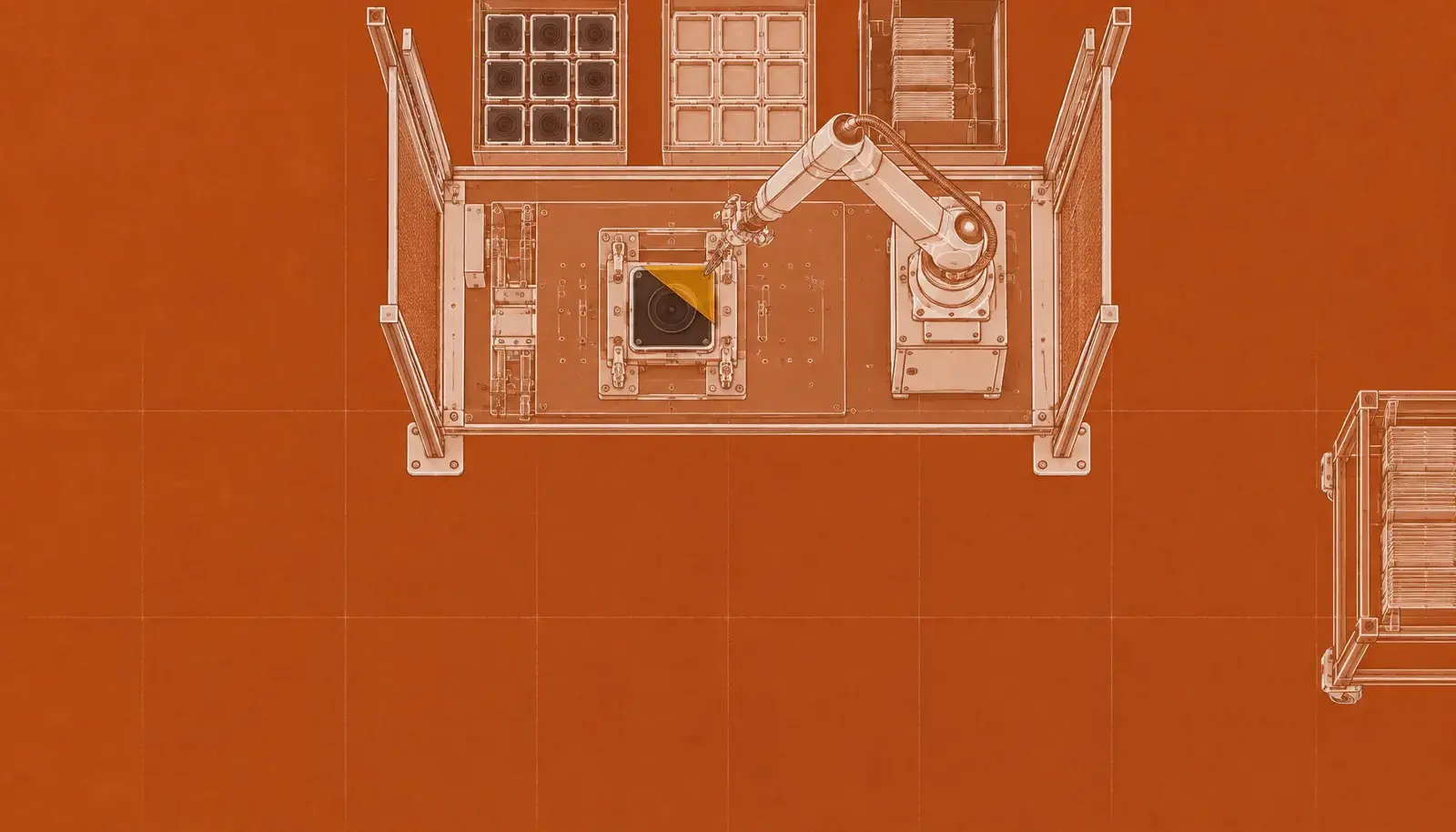
The company builds self-contained robotic stations powered by proprietary foundation models that connect vision, task context and motion. Manufacturers can reconfigure, combine and redeploy the stations across product lines, teaching new tasks through simulation and demonstration instead of hard-coded scripts, the company says.
That pitch targets a familiar limitation of factory automation: conventional robots are often set up for one product and one repeatable task. A change in a part or process can mean new programming, physical adjustments or replacement equipment, and can lead to downtime. Industrial Next’s proposal is to make the station adaptable enough that a product change does not demand a new, lengthy integration effort.
Simulation tackles delicate assembly
Pankau said the company uses a high-fidelity simulation engine to train robots for precise manipulation. The approach is intended to address a data problem: robots have far less relevant physical-task training data than AI systems trained on internet material. In simulation, he said, the company builds a model of the process and its physical dynamics so a robot can learn demanding operations before working with real parts.
Industrial Next’s reported examples come from smartphone manufacturing. Pankau said its stations perform tasks including threading a delicate flex cable and snapping a small connector cap into place—jobs manufacturers had tried and failed to automate. He also described a station that removes protective film from camera modules and buttons, claiming it works at or above human speed with 100% accuracy, including after transfer to a phone model and production line the robot had not encountered before.
The company did not identify the smartphone customer, and the performance figure is Pankau’s account, not an independently detailed test result in the announcement. That leaves important operational measures—such as how quickly a station learns a new task, how often it needs human intervention, and how the claimed accuracy was measured—unanswered.
BMW’s role is evaluation, not deployment
BMW Group Technology Office’s announced partnership is to evaluate Industrial Next’s AI-powered dexterous manipulation for manufacturing. The announcement establishes an evaluation relationship; it does not describe a production deployment, a timetable or a specific BMW factory task.
Industrial Next was founded in 2021 by Pankau and Allen Pan, both former Tesla employees. Pankau previously worked as a lead electrical architect at Tesla and later moved to Waymo; Pan led Tesla’s autonomous factory efforts and later became a chief architect at Neolix.
The company’s current examples suggest it is applying the system to delicate, narrow operations rather than claiming that any robot can immediately take on any factory job. Its next concrete test with a named manufacturer is BMW’s evaluation; no production rollout was announced.
Sources
- Original source TechCrunch techcrunch.com
Other pages read
- Industrial Next industrialnext.ai
Related stories
- Formic Raises $50M to Expand Beyond Task-Specific Factory Robots
- Nucleus Shows Nearly Two Hours of Factory Work With Human Takeovers
- A Robot Turns 15 Minutes of Play Into Dexterous Hand Control
- Google Shows Gemini 4 Argon Tackling Robot Tasks in MuJoCo
- Physical Intelligence Opens Pi API Beta for Robot Models