The Floor
INSECTRON Uses Magnetic Clutches to Tolerate Walking Impacts
INSECTRON is a centimeter-scale hexapod whose magnetic couplings transmit movement during ordinary walking and slip under overload. Tests measured its speed on level and inclined surfaces, and the paper reports that it recovered from vertical perturbations in more than 90% of trials.
Magnetic couplings protect the drivetrain
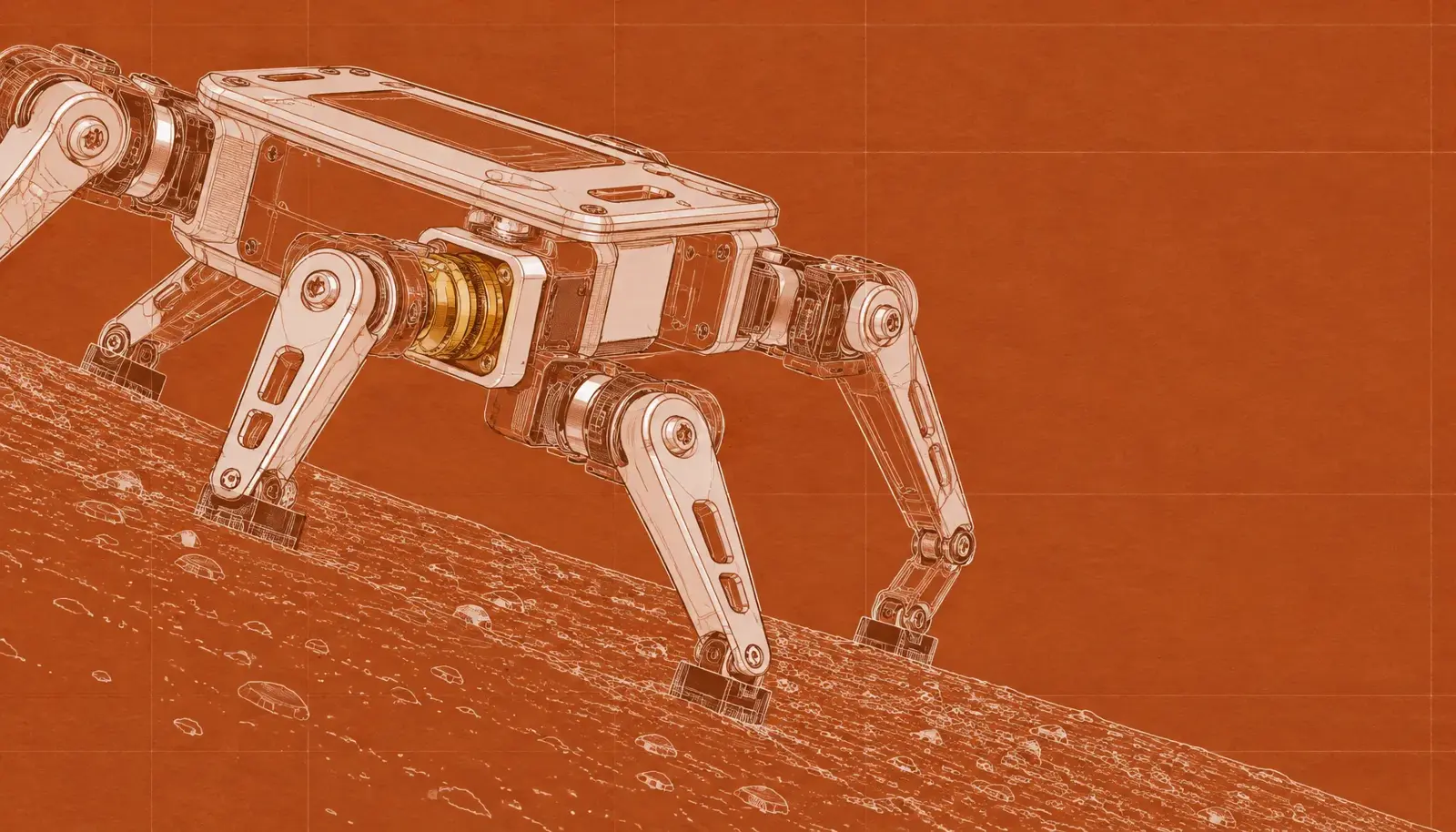
INSECTRON is a hexapod robot measuring 8.7 cm in body length. Its legs connect to a gear-driven system through magnetic couplings instead of conventional mechanical fasteners. The couplings transmit torque during normal operation, but can disengage when a leg encounters excessive load, such as from an obstacle, uneven ground or entanglement. The connection can re-engage after the disturbance is removed.
Source nature.com
The robot has two drive modules, each powered by a DC micromotor and a compact gear transmission. Three legs on each side are mechanically synchronized by the gears. Additional magnetic couplings link the two modules. When the sides experience different loads, including during impacts or contact with uneven terrain, the modules can slip relative to one another, reducing the transfer of sudden torsional loads across the robot.
The authors designed the magnetic connections to make the drivetrain compliant while simplifying assembly and servicing. It also allows tool-free leg replacement and mechanical reconfiguration.
Sensors coordinate the drive modules
Magnet-Hall sensor pairs on selected gears measure the output-gear position on each side. A phase-based closed-loop controller uses those measurements to keep the two drive modules in anti-phase, at 180 degrees. The controller and onboard electronics regulate the modules, while the magnetic couplings provide a mechanical response to disturbances without requiring additional control complexity.
The robot can move straight, turn through differential drive, and spin in place. Its locomotion uses coordinated leg oscillations generated by the two motors, rather than independent motor commands for each leg.
Speed and energy use on level and sloping ground
On a gridded paper reference surface, forward speed rose as drive frequency increased. At 1.5 Hz, INSECTRON moved at 1.8 cm/s, or 0.21 body lengths per second; at 1.9 Hz, it reached 2.7 cm/s, or 0.31 body lengths per second. Electrical power use varied less: it fell from 0.44 W at 1.5 Hz to 0.33 W around 1.8 Hz, then rose to 0.40 W at 1.9 Hz.
Energy use per meter decreased from 24 J/m at 1.5 Hz to 14 J/m at 1.9 Hz. The corresponding Cost of Transport fell from 72 to 42. The paper’s abstract also reports a minimum Cost of Transport of 30 during locomotion experiments.
At the maximum tested frequency, the robot moved at 2.7 cm/s on level ground, 1.6 cm/s on a 3-degree slope and 0.8 cm/s on a 5-degree slope. Power consumption across those three conditions stayed between 0.39 W and 0.41 W. Energy per meter increased with slope, from 15 J/m on flat ground to 26 J/m at 3 degrees and 50 J/m at 5 degrees. The study also evaluated locomotion on different substrates.
Recovery after perturbations
In tests involving vertical perturbations, the robot autonomously recovered in more than 90% of trials, according to the paper’s abstract. The study also reports stable locomotion across multiple slopes and substrates. The magnetic gear-to-leg couplings are intended to protect individual leg mechanisms from overload, while the couplings between drive modules accommodate imbalanced loads. Together, these features let the small robot tolerate disturbances through its drivetrain as well as through its control system.
Sources
- Original source · Paper npj Robotics nature.com
Related stories
- Researchers Demonstrate a Bistable Origami Robot for Multimodal Motion and Grasping in Nonuniform Magnetic Fields
- Flexible TeCoBot modules join to move and manipulate together
- A Humanoid Planner Generates Feasible Movements Without Predefined Contact Sequences
- UCLA’s PhoneBot Uses Android Phones to Control a Walking Humanoid
- Researchers Present LumiTac, a Six-Axis Sensor With a 12 mm-Diameter Sensing Head