The Floor
KAIST Team Trains a Quadruped Policy in 108 Seconds
A KAIST paper reports training trotting and pacing policies from 100,000 simulator samples in 108 seconds, then transferring them to a quadruped without fine-tuning. Hardware tests and contact-implicit trajectory optimization examine how the method handles changing contact modes.
A contact gradient must do more than describe the current step
Exact contact derivatives give a legged robot’s optimizer a precise account of what happens while a foot stays in its current mode. But a foot that is planted cannot use that derivative to learn how to lift off or begin sliding. That limitation puts the learning signal at odds with locomotion, where feet repeatedly move between separating, clamping and sliding contact.
Source arxiv.org
A paper submitted to Transactions on Robotics on October 26, 2026, by Gijeong Kim, Seungbin Oh, Dongyun Kang and Hae-Won Park proposes a way around that conflict. Their method smooths the contact sensitivity used during the backward calculation, while preserving the hard-contact simulation in the forward pass. The authors test it both for learning locomotion policies and for contact-implicit trajectory optimization.
In the paper, the authors write:
“The proposed gradient replaces this sensitivity only in the backward pass, leaving the hard-contact forward solve unchanged and the realized rollout feasible.”
Gijeong Kim, Seungbin Oh, Dongyun Kang and Hae-Won Park, the paper’s authors
One hundred thousand samples, then hardware
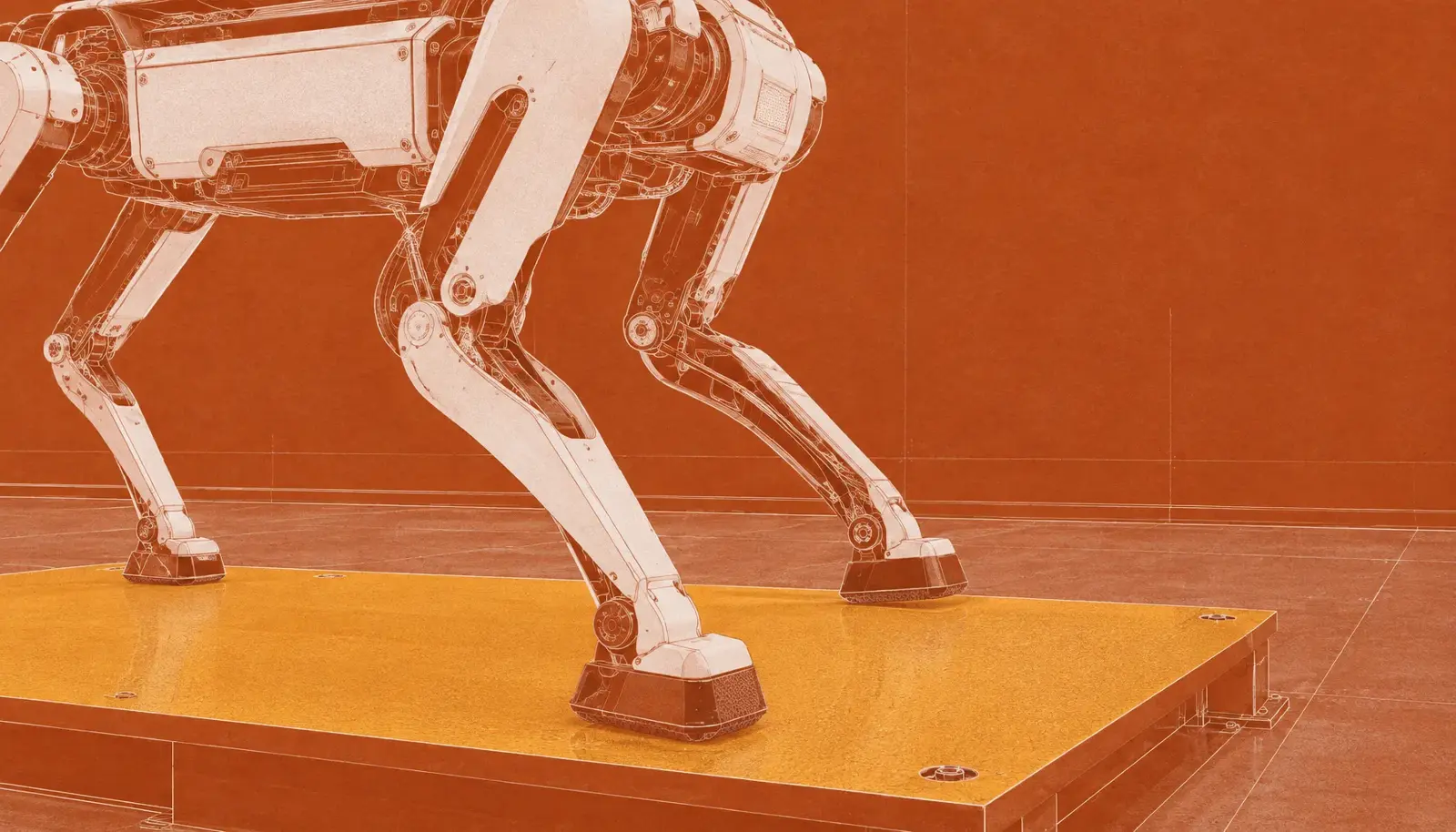
The researchers apply the method to a 45-kilogram quadruped model, then deploy learned policies on a 45-kilogram quadruped robot. For trotting and pacing, training uses 100,000 control steps and takes 108 seconds on a desktop with a 10-core Intel Core i9-10900K CPU. A gait-free policy trained for low-friction conditions takes 172 seconds over 160,000 steps. The policies transfer to the robot without fine-tuning.
The method modifies the derivative calculation, not the simulated contact itself. It relaxes the full frictional contact condition along a central path, giving the backward pass information about nearby contact modes; a Newton iteration starts from the hard-contact solution to find the relaxed evaluation point. The result is a sensitivity that remains continuous across mode transitions and approaches the exact, fixed-mode sensitivity as the relaxation vanishes.
Pushes, debris and a surface below the training range
On hardware, the learned trotting policy traverses scattered debris and recovers from external pushes. Across 14 push trials, the paper tracks lateral-velocity error as it rises during a push and then falls toward zero. In a separate test, the team runs a policy trained over friction coefficients from 0.4 to 1.0 on a boric-acid-coated surface measured at approximately 0.25. The robot slips, its body tilts, then it recovers and keeps walking without falling.
The paper also compares backpropagation through time (BPTT) against proximal policy optimization (PPO) in simulation. In the tested trot task, BPTT learns with a single environment, while PPO first learns the trot at 128 environments; the reported training times are 1.8 minutes and 17.7 minutes, respectively. Those figures describe this shared task and setup, not a general speed advantage across robots or applications. The comparison also notes a computational trade-off: BPTT training time grows with environment count, reaching 17.2 minutes at 64 environments as the available CPU cores saturate.
Trajectory search can change the contact sequence
The same gradient is evaluated in contact-implicit trajectory optimization, where the solver chooses contact timing and footholds rather than following a fixed sequence. The authors report that it finds contact-rich solutions missed by both exact and Signorini-relaxed gradients. In a recovery test involving an external pull, enabling contact-mode changes and foot repositioning gives the optimizer options that a fixed-mode sensitivity can fail to provide.
The evidence is a set of experiments on one quadruped model and robot, not a demonstration across different robot designs. The paper’s practical claim is narrower: for the tested locomotion tasks, a backward-pass treatment of frictional contact can produce policies that run on hardware without tuning there first, while leaving the simulated forward contact solve hard.
Sources
- Original source · Preprint arXiv arXiv:2610.35852