The Floor
Mink 1.4.0 Adds Elastic Constraints to MuJoCo IK
Mink 1.4.0 adds elastic constraints that let MuJoCo inverse-kinematics tasks yield when they become infeasible, rather than making the solver fail. The release also drops Python 3.10 and updates collision-avoidance behavior and IK performance.
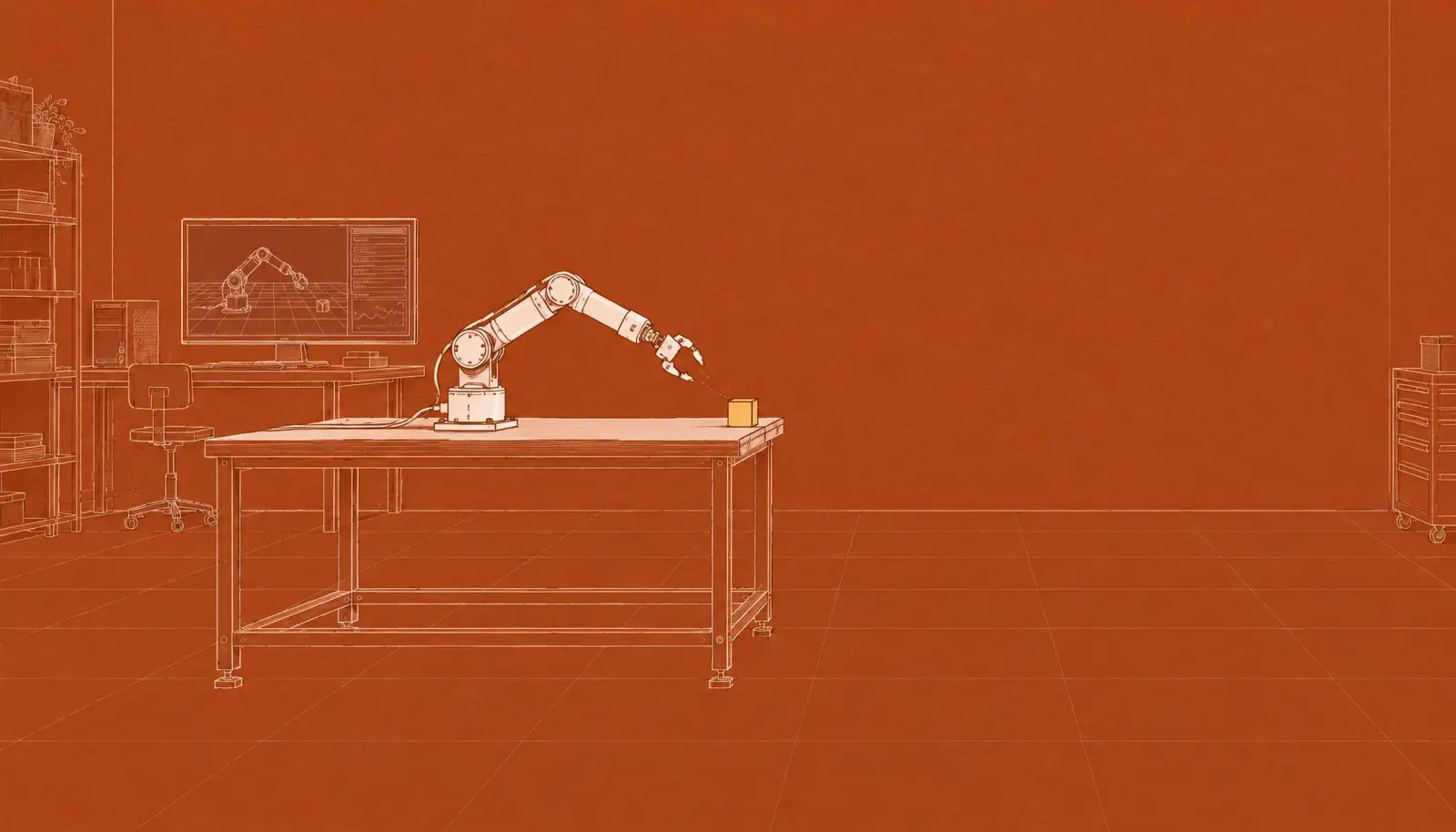
Mink 1.4.0 gives MuJoCo inverse-kinematics solvers a way to keep tracking a task when it can no longer be satisfied exactly: an elastic constraint that yields instead of making the quadratic program infeasible. The release appeared on GitHub and PyPI on November 1, 2026; the project changelog dates the version’s changes to October 31.
When a hard IK target becomes unreachable
Mink is a Python library for differential inverse kinematics built on MuJoCo. Its solver calculates joint-space velocity from a robot’s current configuration and task-space objectives. Before this release, a task passed as a hard constraint had to be met exactly; if a target moved beyond the robot’s reach, or demanded motion faster than velocity limits allowed, the solver could report that no solution existed.
Version 1.4.0 adds mink.Elastic, which wraps a task and passes it through the solver’s constraints argument. The solver first attempts to hold the task as an exact equality. If doing so would exceed the specified penalty, the affected component yields under an exact L1 penalty, while other components can remain exact. The release notes describe the result as the closest feasible solution rather than an infeasible QP.
Position and orientation can yield separately
Developers can set penalties by task component. For a pose task, for example, position and orientation can have different penalties, allowing orientation to give way before position. The penalty has the units of the task error: meters for position and radians for orientation. A zero penalty leaves that component free to yield; ordinary limits and unwrapped hard constraints remain hard.
The distinction matters when a robot has competing objectives. A posture task can pull a redundant arm away from an end-effector target if tracking is treated as an ordinary soft objective. A hard constraint prevents that drift while feasible, but can fail once the target becomes unreachable. Mink’s tutorial presents the elastic option as a middle course: exact tracking when possible, controlled give when it is not. The release example applies it to an end-effector task, while the tutorial shows separate position and orientation penalties.
Faster task assembly, with collision-limit changes
The release also updates the IK path. Fused native error and Jacobian kernels for FrameTask and RelativeFrameTask make task quadratic-program assembly about 1.5 times faster; the changelog reports about a 1.15-times end-to-end improvement on its G1 benchmark. When callers leave limits unset, Mink now reuses a cached configuration limit, a change the project reports as roughly twice as fast on UR5e and 5.6 times as fast on G1. Those are project-reported benchmark results, not a general performance guarantee.
Collision avoidance receives behavior and validation changes as well. The default collision-detection distance rises from 0.01 to 0.05 meters, and the per-step bound no longer scales with the inverse of the timestep. The changelog says the former default could let geometries pass undetected within a narrow band; it cites an UR5e at 50 Hz penetrating 18 millimeters. Developers using collision limits may need to retune gain, and the release now rejects invalid distance and gain settings.
Python 3.10 users must stop at an earlier release
Mink 1.4.0 requires Python 3.11 or newer, ending support for Python 3.10. The release also changes the sign convention used by RelativeFrameTask.compute_error and compute_jacobian to match FrameTask; the project says IK solutions do not change. PyPI lists packages for Python 3.11 through 3.14.
For teams updating existing controllers, elastic constraints are the main functional addition, but the Python floor and collision-limit changes deserve a review before upgrading. A task that should never yield—such as keeping a planted foot fixed—should remain a plain constraint. Elasticity is for objectives that should be exact until the robot’s reach, speed or other limits make exact tracking impossible.
Sources
- Original source · Release notes Mink project on GitHub · page 1 github.com
Other pages read
- Python Package Index pypi.org
- Mink project on GitHub · page 2 github.com
- Mink documentation kevinzakka.github.io