The Floor
Peking Team Cuts Continuum-Arm Tip-Prediction Error 27%
A Peking University team’s hybrid model reduced tip-position prediction error by 27% on six-second rollouts of a tendon-driven continuum arm, the team reports. The researchers also tested the method on a physical soft tail under shifted actuation frequencies.
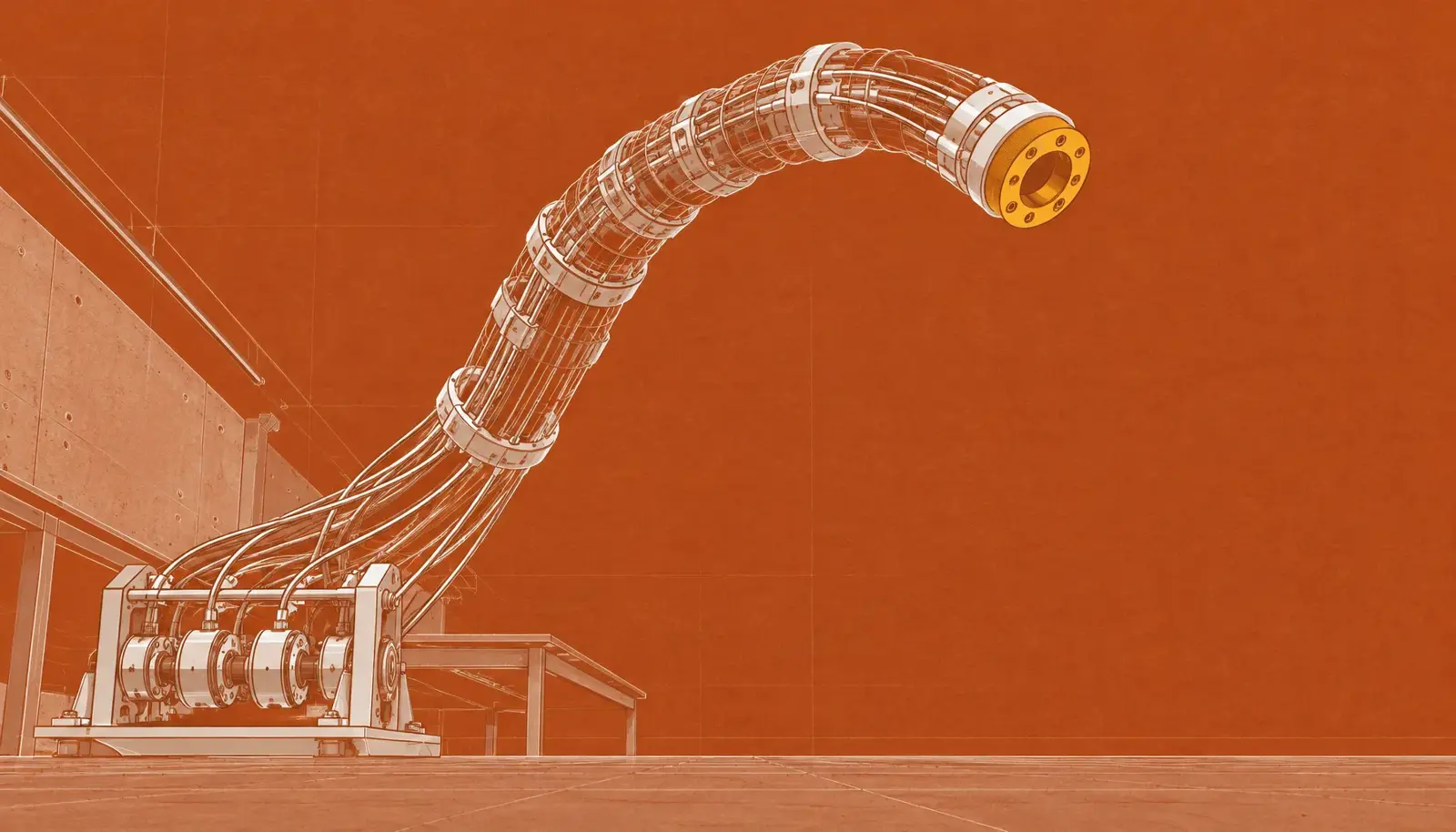
Peking University described a new method for forecasting soft-robot motion on Oct. 23, reporting that it reduced a continuum arm’s tip-position error by 27% during six-second predictions. The study, by Ahsan Tanveer, Rahdar Hussain Afridi, Waqar Hussain Afridi, Feitian Zhang and Guangming Xie, appeared in the 2026 proceedings of Robotics: Science and Systems, held in Sydney in July.
The method combines an estimate of the arm’s settled shape with a learned correction for motion between settled states. That split targets a familiar problem in long predictions: small step-by-step errors compound, leaving a model with an increasingly inaccurate account of where a flexible robot is.
“Multi-step motion prediction for continuum robots is difficult, especially under actuation distribution shift, where error accumulation can distort the predicted steady response and destabilize rollouts.”
Ahsan Tanveer et al., “Stabilizing 3D Continuum-Arm Rollouts via Equilibrium Anchoring and Feature-Lifted Residual Learning”
An equilibrium estimate checks accumulated drift
The researchers’ equilibrium prior learns how the tendon-driven, three-dimensional arm settles under a given actuation. During each prediction step, a contractive update draws the forecast toward that estimated equilibrium. A separate residual model, trained on dynamic trajectories, accounts for transient movement that the equilibrium estimate cannot capture.
The two components use different data: static equilibrium samples train the anchor, while motion trajectories teach the residual model. The anchor was fitted from 4,520 static samples, with a correction strength of 0.5, according to the project site. The design aims to keep a prediction physically plausible without treating the arm as if it moves directly to its resting shape.
Six seconds, 200 steps and shifted actuation
In simulation, the team tested 200-step rollouts—six seconds of predicted motion—under actuation stronger and faster than the training conditions. Across 19 test trajectories, the hybrid model reduced backbone-position root-mean-square error by 26% and tip-position RMSE by 27% against the equilibrium prior, according to the conference paper. Its rollout remained stable across all the tested trajectories.
On the project page, the tip RMSE is reported as 26.10 centimeters for the equilibrium prior and 19.15 centimeters for the hybrid model. The residual-only predictor recorded 20.62 centimeters on that measure, while the hybrid also slightly lowered backbone RMSE compared with residual-only: 11.34 centimeters versus 12.21 centimeters. Those comparisons show gains on the reported test set, not a general guarantee for other arms or actuation patterns.
A soft-tail test adds physical evidence
The team also evaluated the approach on a physical PneuNet soft tail under a change in actuation frequency. On the project site, the hybrid is reported to have reduced mean RMSE by at least 51% against the equilibrium prior and at least 74% against the residual-only model. That test adds hardware evidence to the arm simulations, though the two evaluations use different robot setups.
On a Van der Pol benchmark, the authors report no catastrophic rollouts for their hybrid method, while a combined Koopman baseline failed on harder initial conditions. The project also lists a pendulum-cart benchmark, but its public summary does not provide a numerical result for that test.
Prediction is not yet a control demonstration
The work measures how closely the model forecasts motion; it does not report a completed manipulation task controlled by those forecasts. Steadier predictions could let a controller compare candidate moves in simulation before moving the real robot, Peking University says, but it presents that as a potential use, not a demonstrated result.
For now, the concrete result is narrower: under the paper’s six-second, shifted-actuation tests, the equilibrium-anchored hybrid lowered continuum-arm position error and stayed stable across 19 simulated trajectories, with a separate frequency-shift test on a soft tail.
Sources
- Original source Robotics: Science and Systems XXII Online Proceedings roboticsproceedings.org
Other pages read
- Peking University News newsen.pku.edu.cn
- Anchored Rollouts project site anchored-rollouts.github.io