The Floor
ETH’s ANYmal-D Solves a Giant Rubik’s Cube With Its Feet
ETH Zürich researchers report three autonomous solves of a giant Rubik’s Cube by an ANYmal-D quadruped using only its feet. The system combines onboard RGB-D perception, a cube-solving planner and learned whole-body skills, with each solve taking about 8–9 minutes.
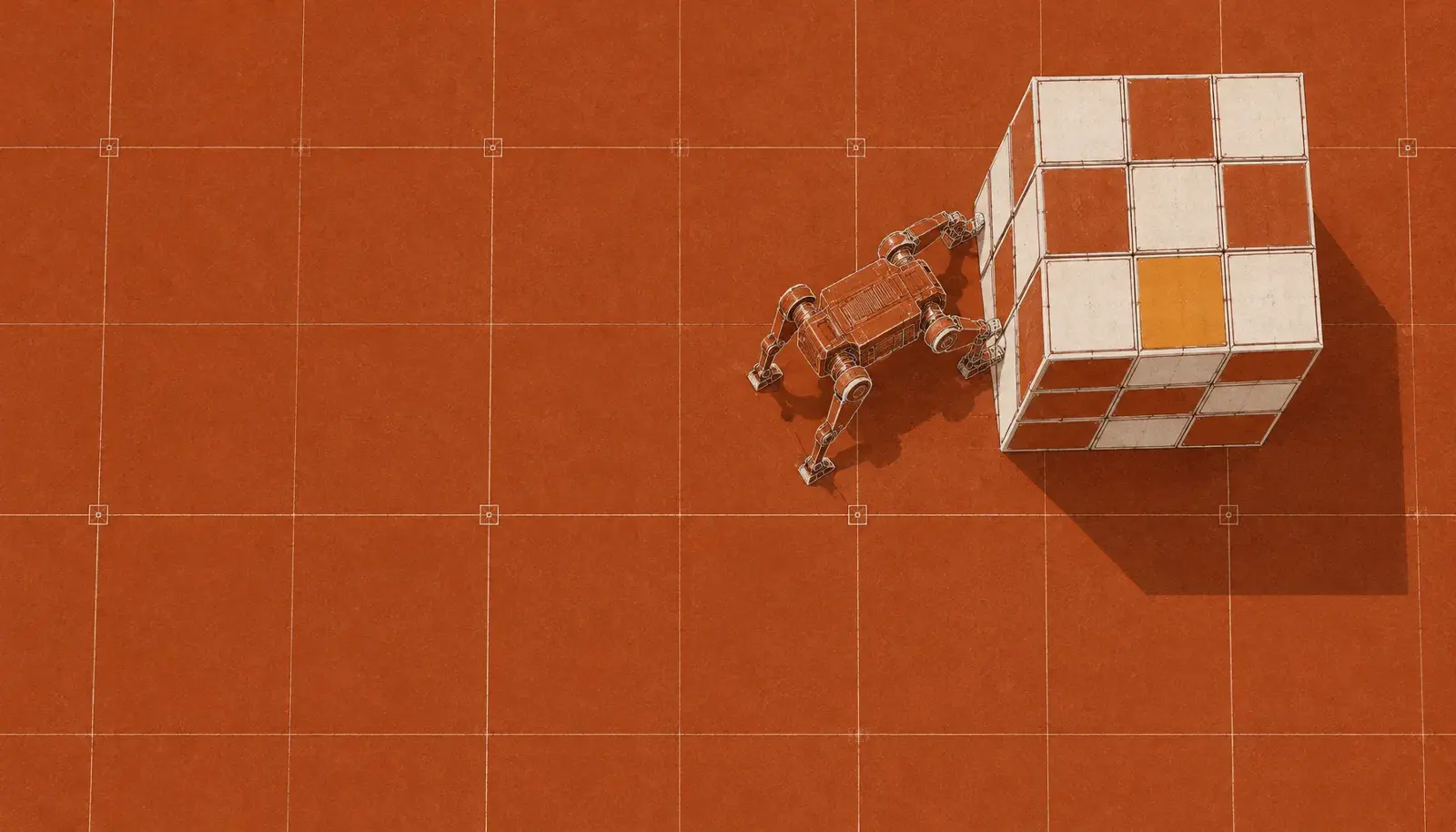
Three autonomous solves, about 30 steps each and 8–9 minutes per attempt: ETH Zürich researchers have taught an ANYmal-D quadruped to solve a giant Rubik’s Cube using only its feet. The team describes the work in a paper submitted to arXiv on October 17, 2026. The robot scans the puzzle, plans a solution and carries it out by flipping the cube and turning its layers while keeping its balance.
Three solves took up to nine minutes
The demonstration combines perception, planning and learned physical skills rather than relying on a human to direct each move. The robot first gathers views of the cube, reconstructs its color state and sends that state to a cube solver. A planner then translates the solution into a sequence of robot actions, including repositioning, flips and layer rotations.
Between actions, onboard RGB-D perception updates the cube’s pose so the quadruped can move into position for the next skill. During a skill, the learned policy uses front-camera depth images and the robot’s proprioception to generate joint-position targets. That loop matters because an unintended turn of a cube layer can invalidate later operations.
ANYmal-D builds a cube state from partial views
The perception system uses a ZED X Mini camera to estimate the cube’s position and orientation and identify visible facelet colors. The robot combines partial cube nets from different views, collected while moving and flipping the puzzle, to recover the full state needed by the solver. Researchers segment the cube with SAM 3, refine its geometric pose with iterative closest point registration and classify facelet colors in CIE-LAB space.
In the reported evaluation, geometric pose estimation at distances up to 2 meters has a median position error of about 2 centimeters and a median rotation error below 3 degrees. Facelet classification reaches 100 percent accuracy indoors and 98.7 percent outdoors across the evaluation sequences. Those figures describe perception tests, not a general success rate for solving cubes.
One foot pins while the other turns
The robot learns three skills: flipping the cube toward itself, flipping it away, and rotating the upper layers counterclockwise. For a layer turn, one foot holds the cube steady while the other pushes the layers. The clockwise version comes from reflecting the counterclockwise policy at deployment, rather than training a fourth policy.
The researchers train teacher policies in simulation with privileged observations, then distill them into recurrent student policies that rely on the robot’s onboard depth cameras and proprioception. Training randomizes factors such as robot and cube placement, mass, contact friction and external pushes. The project page also shows the skills tested on low-friction floors and cobblestones, and with disturbances including a pulled leg or a cube pushed away.
The result is a cube-specific test of whole-body control
The work puts locomotion and manipulation into the same control problem: the robot must use its legs to interact with the object without losing the stance and balance needed to continue. The authors write,
“These results show that combining onboard perception with coordinated pedipulation enables a quadruped to complete extended multi-step physical tasks.”
Lukas Amiet, Gabriel Sánchez-Blanco Repgen, Mayank Mittal, Victor Klemm, Andrei Cramariuc, Marco Hutter and Cesar Cadena, “Solving a Giant Rubik’s Cube with a Quadruped Robot”
The result is a research demonstration, not evidence that ANYmal-D can handle arbitrary household or industrial objects. The project page shows individual flips on a small box and a cylindrical container, but reports the three full autonomous solves on the Rubik’s Cube. Can the same perception-and-control chain support complete, multi-step tasks on other articulated objects?
Sources
- Original source ETH Zürich Robotics Systems Lab leggedrobotics.github.io
Other pages read
- arXiv arxiv.org