The Floor
Perseverance Takes Mars Driving Record at 28.10 Miles
NASA’s Perseverance rover passed Opportunity’s Mars driving record on October 11, reaching 28.10 miles after a 91.31-meter drive. The milestone highlights AutoNav’s role in the rover’s progress toward ancient terrain at Jezero Crater.
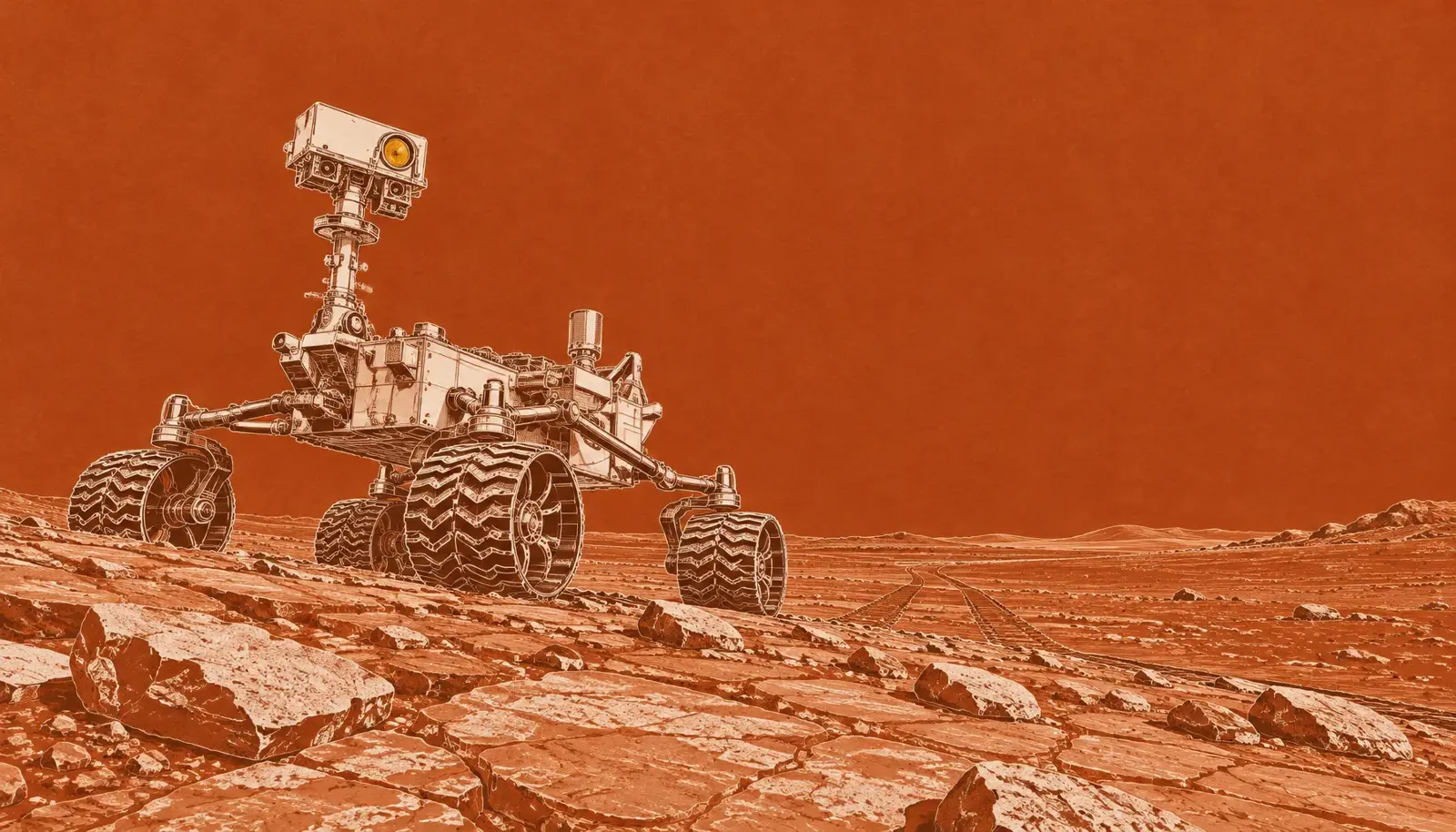
A 299.6-foot drive on October 11 pushed NASA’s Perseverance rover past a record that had stood since its predecessor’s Mars campaign. Perseverance’s odometer reached 28.10 miles (45.22 kilometers), edging beyond Opportunity’s 28.06 miles (45.16 kilometers). The six-wheeled rover reached the mark on its 2,006th Martian day, or sol, after five and a half years on Mars. Opportunity took nearly 15 years to cover its record distance.
A 91-meter drive puts Perseverance ahead
The record-setting drive measured 91.31 meters. It took place as Perseverance traveled toward Idubi, an area in Lac de Charmes, near the western rim of Jezero Crater. The rover is examining terrain that may rank among the oldest explored in the solar system, NASA says. At Idubi, the science team hopes to find traces of ancient hydrothermal systems.
The milestone marks a change in what a Mars rover can do between instructions from Earth. Perseverance’s AutoNav system takes images as the rover moves, builds a three-dimensional map of hazards and plots a path between waypoints chosen by rover planners. NASA describes that process as “thinking while driving.” The rover can do it at or near its top speed, covering as much as 1,351 feet (412 meters) in a sol.
AutoNav handles more than 90% of the distance
Perseverance has used AutoNav to assess terrain for more than 90% of its total distance. The comparable figure for the first Martian AutoNav system, aboard Opportunity and its twin Spirit, was about 5%. NASA’s first Mars rover, Sojourner, assessed the path ahead using 20 measurement points; Perseverance processes 600,000 with every look.
That autonomy has limits: planners on Earth still choose the waypoints. But the rover can evaluate hazards and manage much of the driving between them without waiting for a human to specify each movement. “The rover that broke this record did so by making its own decisions about the path,” said Mark Maimone, deputy team chief for robotic operations on Perseverance. Newer software lets the rover steer less, roll more and check its position against orbital maps during a drive, Maimone said.
Opportunity’s 15 years, compressed into five and a half
Opportunity explored Mars from 2004 to 2018 and drove for 5,111 sols. It completed the first extraterrestrial marathon in 2015, then held the distance record Perseverance has now surpassed. Spirit logged 4.8 miles (7.7 kilometers) before the Martian winter ended its mission in 2010; Curiosity, which landed in Gale Crater in 2012, has traveled more than 23.65 miles (38.07 kilometers).
Perseverance’s original mission called for no more than 12.4 miles of driving. “We’ve blown well past that,” said Steven Lee, project manager of the Curiosity and Perseverance rovers at NASA’s Jet Propulsion Laboratory. The rover’s mobility systems remain fully operational, Lee said, and he cited favorable extended-ground-life test results as reasons the team expects it to keep adding distance. NASA approved the mission’s first extension in October, covering crater-rim exploration roughly through the end of 2028.
From Lac de Charmes toward Rainbow Falls
The extra mileage gives Perseverance access to more outcrops and a broader range of Martian geology. Its route has taken it from an ancient lakebed up a fossilized river system, where it found a potential biosignature at a rock named Cheyava Falls, and onto the crater rim. There, the rover is examining impact-generated rocks about 4 billion years old and searching terrain where an ancient hydrothermal habitat may have existed.
The rover will continue along the rim after Lac de Charmes, then head south toward Rainbow Falls. The target is a 328-foot-wide block of ancient crust uplifted by the impact that formed Jezero Crater. Perseverance has collected 29 rock and regolith samples from the crater floor, river delta and rim, tying its growing mileage to a widening geological record.
Sources
- Original source · Government or agency page NASA Science science.nasa.gov