The Floor
RoboCombine Exposes Why Robot Skills Fail at Handoffs
A new benchmark finds that robots often fail when one familiar manipulation skill must begin from the physical state left by another. RoboCombine tests skill chaining in simulation and on a dual-arm robot, while a training method called PRTI improves handoff performance without composed-task demonstrations.
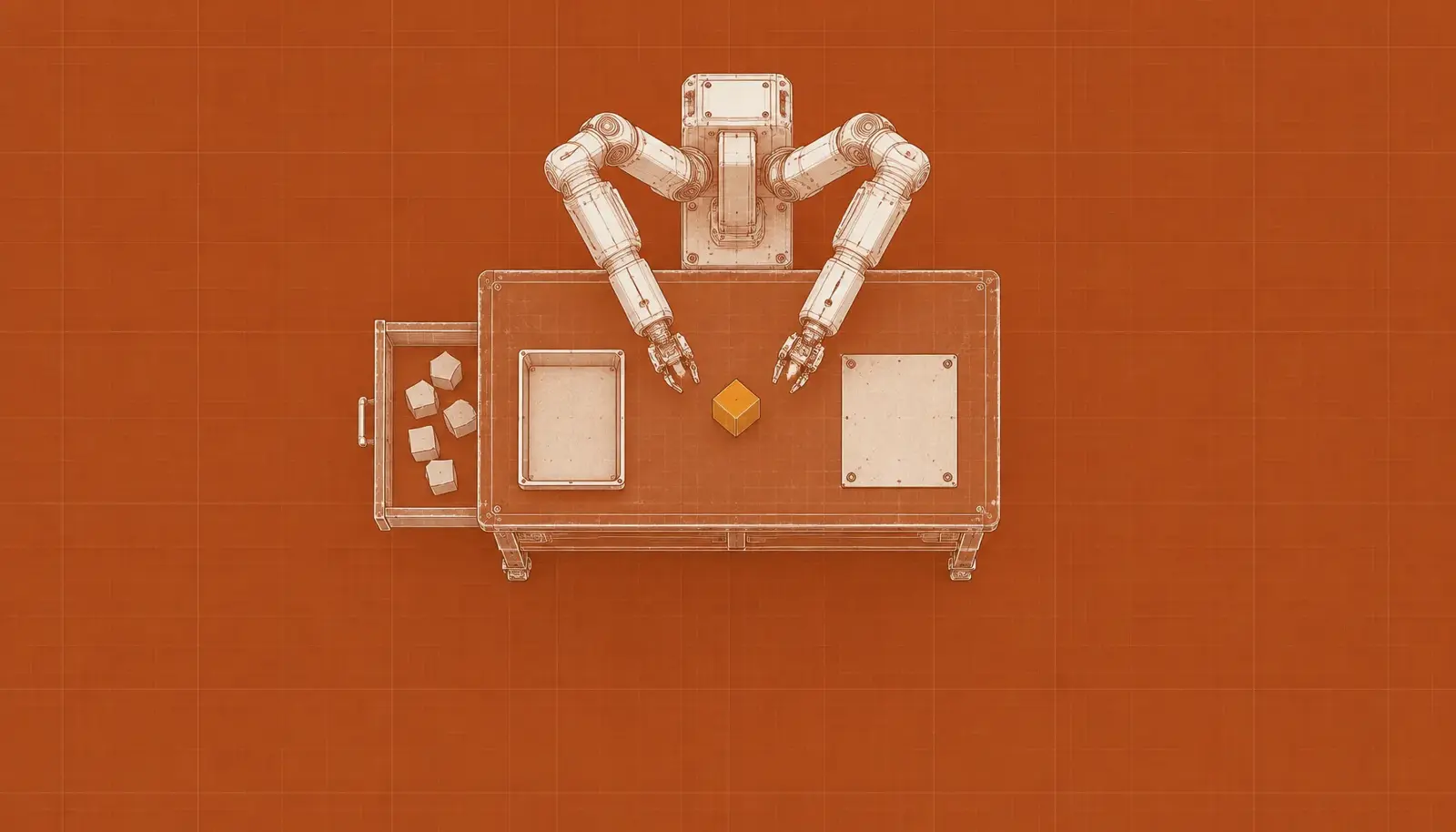
Even with the correct skill order and handoff timing supplied, a robot completed both stages of a task in only 18.16% of RoboCombine’s simulated trials after a new training method. The benchmark, introduced in a paper posted to arXiv on October 11, tests whether vision-language-action models can chain familiar manipulation skills into combinations they were not trained to perform as complete sequences. Its central finding is that a skill that works on its own may fail when it starts from the physical state its predecessor leaves behind.
“RoboCombine reveals that atomic competence alone does not ensure ordered execution.”
The authors write that line in their paper, which introduces the benchmark alongside a diagnostic system called Hierarchical Subtask Execution, or HSE. Xupeng Zhang, Yantai Yang, Chang Guo, Zhaokai Yin and Zhipeng Zhang, AutoLab, Shanghai Jiao Tong University
RoboCombine measures the jump between skills
The simulated benchmark contains 19 two-stage tasks assembled from familiar atomic instructions, such as placing an object and then interacting with a fixture. Each task receives 20 evaluation rollouts, for 380 episodes per policy variant. Training uses isolated skill trajectories rather than complete demonstrations of the tested combinations.
RoboCombine counts an episode as an ordered success only when both subtasks finish in the specified order. It also measures transition conversion: how often the second subtask succeeds among trials where the first one did. That distinction identifies a failure hidden by isolated-skill scores: the first action can succeed, yet leave an object, end effector or contact arrangement that prevents the next policy from proceeding.
HSE separates three parts of execution: the queue of skills, the cue that triggers a switch, and the policy that performs each skill. In its oracle test, the benchmark supplies the correct order and handoff cue, leaving the downstream policy to act from the state the first skill actually produced. The low success rate therefore isolates execution across the boundary rather than errors in choosing a subtask or deciding when to switch.
PRTI lifts simulated success, but most trials still fail
The researchers call the mismatch between familiar training starts and unfamiliar handoff states the “start state gap.” Their response, Pose Robust Task Initialization (PRTI), expands training for each atomic skill with task-valid starting states drawn from late portions of successful single-skill demonstrations. The policy still receives one atomic instruction at a time, and the method does not use complete demonstrations of composed tasks.
Under oracle HSE, the base policy records 2.63% ordered success. Random initial-state perturbations raise that to 4.21%, while an oracle that resets the robot’s pose between skills reaches 9.47%; PRTI reaches 18.16%, or 69 successes in 380 trials. The reset control leaves objects and contact states unchanged, and PRTI acts directly from the handoff state. Even with the improvement, more than four out of five simulated sequences fail to complete in order.
A separate comparison highlights the limits of training on a small set of complete instructions. Full-instruction fine-tuning reaches 40.0% ordered success on combinations represented in training, but averages 7.7% on two held-out recombination sets. The authors interpret the gap as evidence that the model fits observed sequences more readily than it learns to recombine skills.
The AgileX test uses a different score
The paper also evaluates a dual-arm AgileX robot on 13 physical tasks composed of two to five steps, with five rollouts per task. Here the researchers report mean progress, not the percentage of fully completed tasks: each rollout earns credit for the furthest ordered milestone it reaches. That distinction matters when comparing the hardware figures with the simulated success rates.
With a specified skill order and online progress-based handoffs, Order-HSE averages 0.67 mean progress, compared with 0.35 for full-instruction fine-tuning on collected compositions and 0.16 for direct full-instruction execution. Under a matched oracle-switching protocol, adding PRTI raises mean progress from 0.75 to 0.80. PRTI improves eight of the 13 tasks, matches the oracle result on four and falls below it on one.
The result stops short of open-ended autonomy
In HSE, a language model converts a composed instruction into an ordered list drawn from a closed set of atomic skills; it does not generate the robot’s actions. The oracle simulation results also provide the correct order and switching cue, while the hardware study uses a fixed task order. The experiments therefore measure skill recombination under controlled conditions, not a fully autonomous system that must plan, detect progress and recover from failure without supplied structure.
The authors limit their conclusions to recombining familiar atomic task labels. Their tests do not establish generalization to unseen skills, new robot embodiments or open-ended real-world environments.
Sources
- Original source · Preprint Exploring the Limits of Combinatorial Generalization in Embodied Manipulation arXiv:2610.15425