The Floor
RoboEval Opens a Bimanual Challenge With 3,060 Demonstrations
RoboEval opened its CoRL 2026 diagnostic bimanual-manipulation challenge on October 12, with 3,060 human demonstrations and an eight-task MuJoCo evaluation. The benchmark scores task outcomes alongside safety, efficiency and coordination, with submissions due November 1.
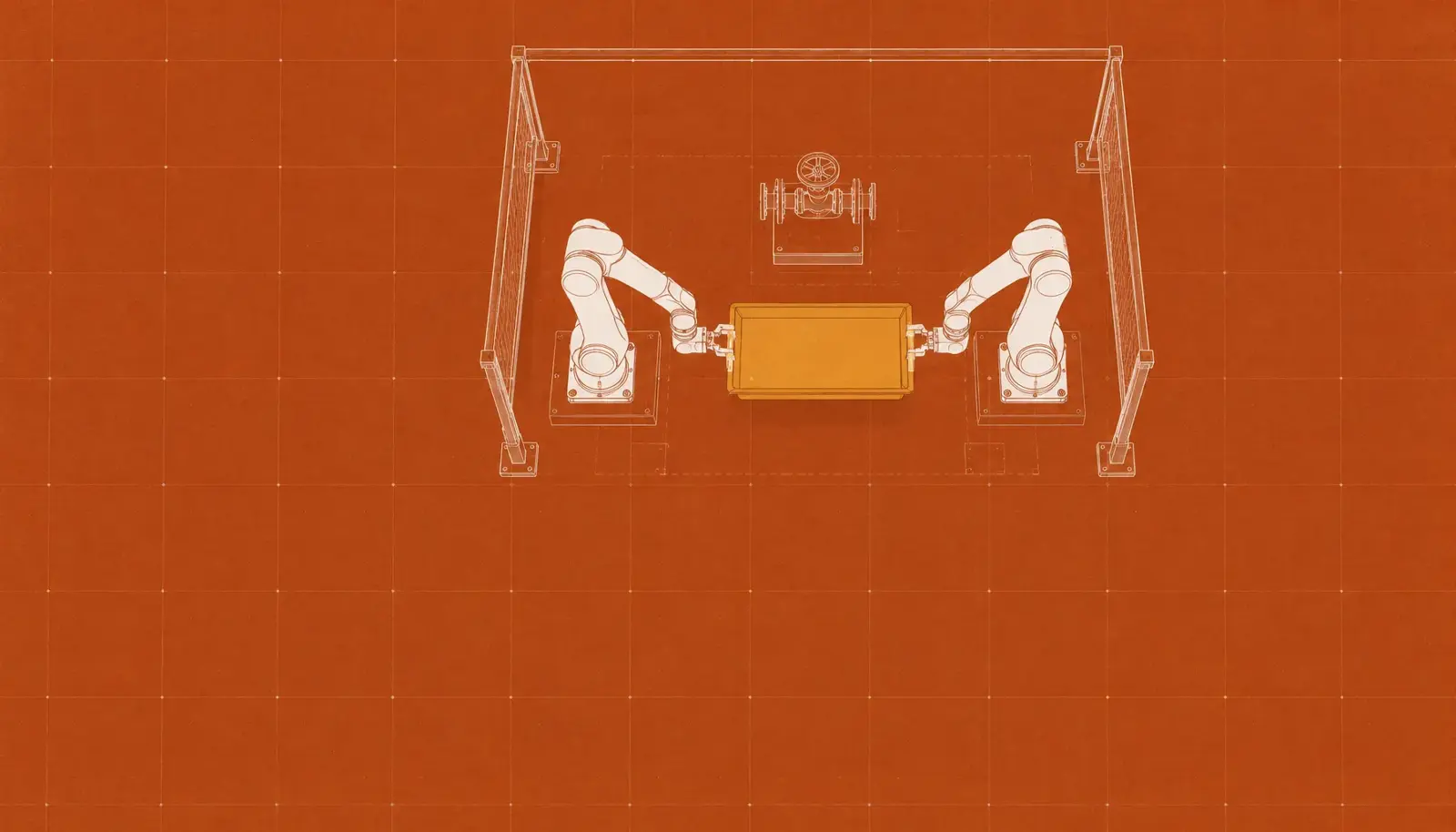
3,060 demonstrations, one diagnostic score
RoboEval released 3,060 human demonstrations when it opened its diagnostic bimanual-manipulation challenge on October 12. The competition uses those examples to test policies in MuJoCo with a simulated pair of Franka Panda arms, but it does not rank entrants on task completion alone. Its RoboEval Diagnostic Score combines outcome, safety and stability, efficiency, and coordination.
The challenge is Track 2 in the CoRL 2026 Embodied AI Benchmark and Sim-to-Real Challenge Suite. Entrants must submit one policy covering all eight task families, each evaluated in a version that varies both object position and orientation. Training demonstrations span 30 task variants, so teams may draw on more examples than the eight variants used for scoring.
Success is only 40% of the score
Outcome accounts for 40% of the score; safety and stability account for 30%, efficiency 20%, and bimanual coordination 10%. The 14 metrics include success and task progression, arm-speed mismatch, gripper-height offset, collisions, slips and motion jerk. Behavioral measures are compared with human demonstrations for the same task, and their contribution is scaled by outcome so a motionless policy cannot win by avoiding collisions.
Stage annotations add detail to a failed attempt. In the bookshelf-stacking task, for example, the evaluator tracks pushing, grasping, lifting and placing as separate stages. A policy that grasps the book but fails to place it can therefore receive partial task-progression credit, rather than being indistinguishable from a policy that never reaches the object.
Eight tasks, from trays to valves
The task set includes lifting a tray or pot, stacking cubes, handing over a cube, packing a box, picking up a book, stacking a book on a shelf, and rotating a valve. The released LeRobot dataset contains RGB views from five 256-by-256 cameras, proprioception, end-effector delta actions and a language instruction for each episode. Demonstrations were collected through VR and keyboard teleoperation.
Teams can use ACT, Diffusion Policy, GR00T or other policy architectures; the rules also permit outside pretraining and additional demonstrations collected with the provided tools. The benchmark, assets and demonstration data carry an MIT license. The challenge is a simulation evaluation, not a test of whether a policy transfers to a physical robot.
Submissions close November 1
Entries must include a policy checkpoint, evaluation logs and a short technical report. Submissions close at 23:59 Anywhere on Earth on November 1, 2026, which the challenge page lists as 11:59 UTC on November 2. Organizers plan to announce winners on November 9, ahead of presentations at the CoRL workshop in Austin on November 12.
That schedule leaves teams to train and evaluate across every required task before the deadline. The leaderboard will judge not only whether a simulated robot completes a task, but how it handles the object, coordinates both arms and moves through the attempt.
Sources
- Original source RoboEval · page 1 robo-eval.github.io
Other pages read
- RoboEval · Challenge rules robo-eval.github.io