The Floor
MonoRace Posts a 16.56-Second Win With One Camera
TU Delft’s MonoRace drone completed two laps of an 11-gate course in 16.56 seconds, using one camera and an onboard motion sensor. A paper in Science Robotics details how its onboard vision and control system won a 2025 Abu Dhabi competition against autonomous teams and three champion-level pilots.
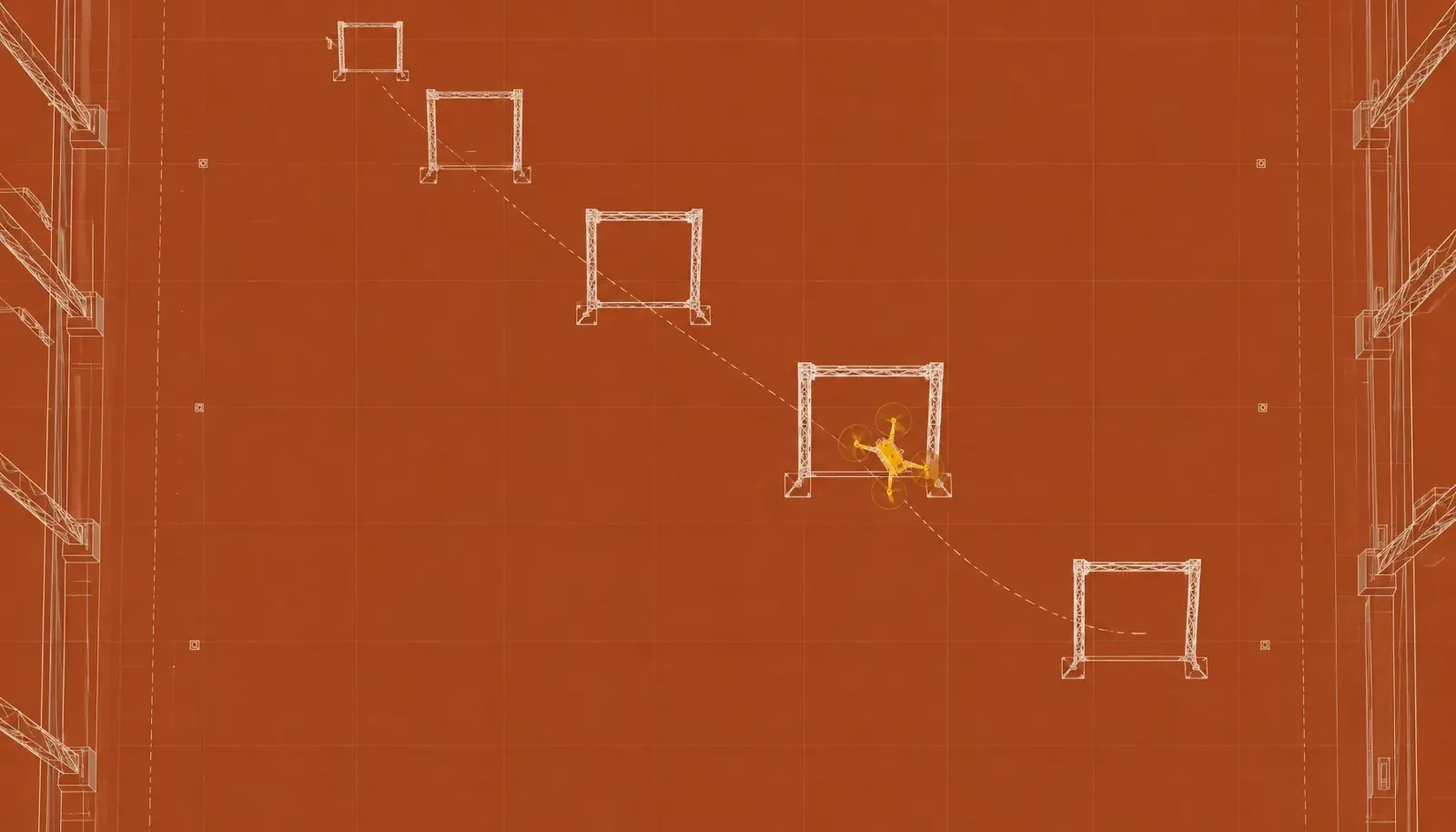
Two laps in 16.56 seconds
MonoRace completed two laps of an 11-gate course in 16.56 seconds, a time that helped a single-camera autonomous drone beat three champion-level human pilots. The result, achieved at the 2025 Abu Dhabi Autonomous Drone Racing Competition, is detailed in a paper published in Science Robotics on October 14, 2026.
The Delft University of Technology system raced with one forward-facing, rolling-shutter camera and an onboard inertial measurement unit (IMU), which measures the drone’s movement. It did not rely on external motion tracking. The authors report speeds up to 100 kilometers per hour on the competition track.
“The proposed approach won the 2025 Abu Dhabi Autonomous Drone Racing Competition (A2RL), outperforming all competing AI teams and three human world champion pilots in a direct knockout tournament,” write Stavrow A. Bahnam, Robin Ferede and their co-authors.
A gate detector feeds a 500-Hz controller
MonoRace divides perception and control into linked stages. A neural network segments racing gates in camera images; the IMU and a model of the drone help estimate its position and motion. The team also developed an offline procedure that uses known gate geometry and onboard flight data to refine state-estimation parameters, including camera calibration.
For control, a small Guidance-and-Control Network maps the estimated state directly to motor commands, bypassing the usual inner-loop controllers. The network has three layers of 64 neurons and runs on the flight controller at 500 hertz. The team trained it in simulation with reinforcement learning, varying the simulated drone’s properties to help the controller handle differences between the model and real flight.
The course tested more than speed
Organizers held the April 2025 competition in a 100-by-30-meter indoor hall. Its 11 square gates had 1.5-meter openings, and the course included a split-S maneuver: the drone passed through an upper gate, then dove through a lower one in the opposite direction. Organizers supplied the drone and set the course, leaving the Delft team without control over either.
MonoRace won the AI Grand Challenge, the AI-versus-human event and the drag race, according to the paper. It placed third in the four-drone race because it lacked collision-avoidance capability. That result marks an important boundary: its fastest performance came in solo flight around a known gate course, not in traffic with other drones.
Sensor faults exposed the limits
The paper also records failures during testing. In one set of 10 flights, camera interference corrupted between 8% and 75% of captured images; two flights ended in crashes, including one after complete camera failure. The researchers describe software checks that reject suspect visual measurements and use the drone model to compensate when the IMU saturates.
In a separate test, the winning controller completed five of seven flights, with both crashes attributed to IMU saturation. Model-based correction helped the estimator continue through high-acceleration maneuvers, but those results do not erase the failures. The authors also note that the vision pipeline depends heavily on rectangular gates and that the system lacked collision avoidance in the multi-drone event.
MonoRace’s 16.56-second run shows what onboard vision and direct motor control can achieve on a demanding, defined course. Its documented third-place multi-drone finish and sensor-related crashes put equally concrete limits around that result.
Sources
- Original source · Paper Science Robotics science.org
Other pages read
- arXiv arxiv.org