The Floor
Ropedia preprint details dataset of 1,589 scanned scenes
Ropedia Xperience 2 combines metric-scale scans of real scenes with egocentric recordings of human activity. The paper describes ways to reuse the captures for model evaluation and robot learning, including simulation and trajectory generation.
A paired environment-and-behavior dataset
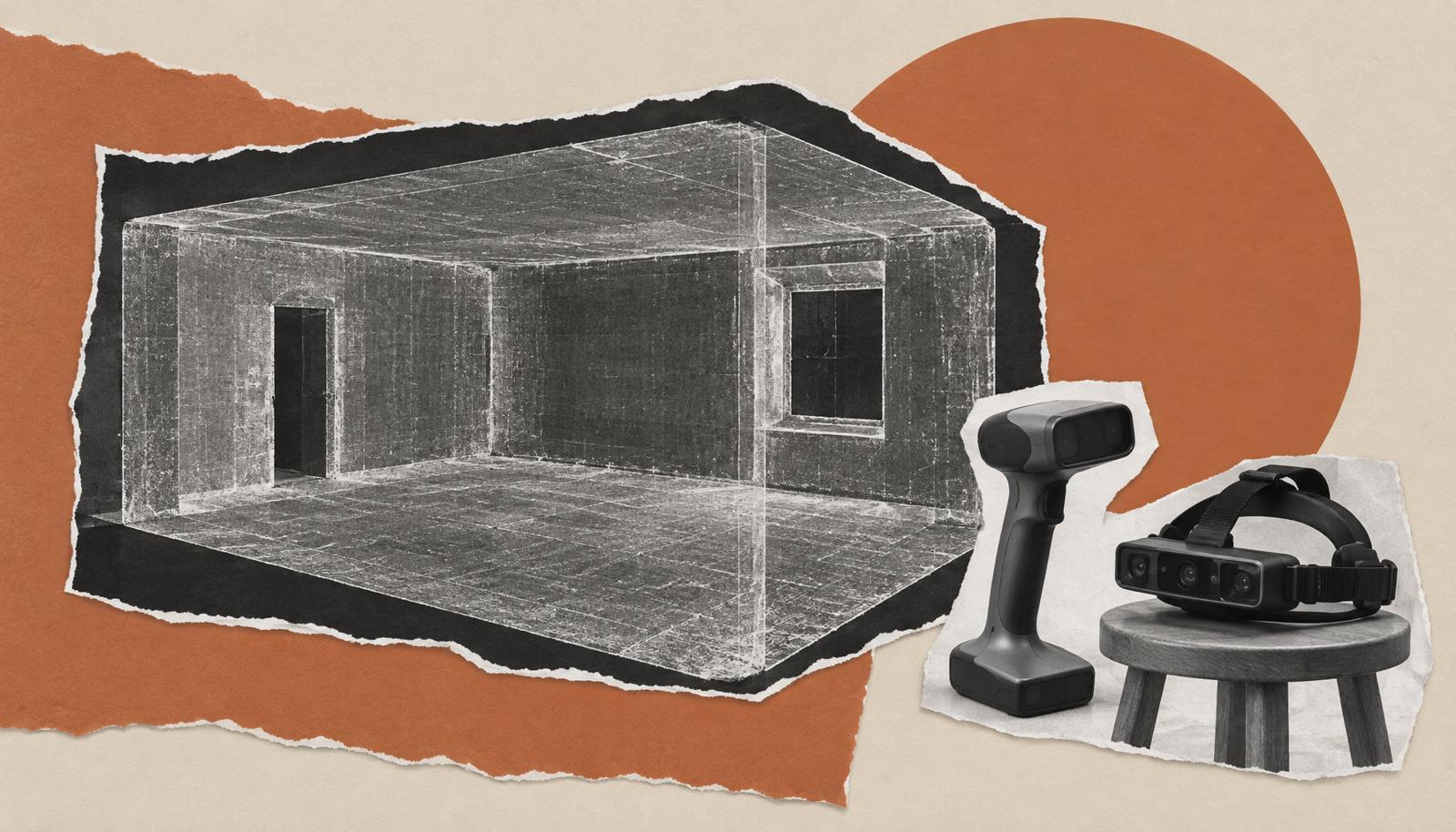
Ropedia’s Xperience 2 pairs 1,589 released metric-scale 3D scans with 4,230 egocentric recordings covering 74 tasks and 131 hours. The arXiv preprint was submitted on Nov. 12, 2026. The collection combines LiDAR scans of real scenes with first-person recordings of human activity. Its registration pipeline can place corresponding scene geometry, video, camera trajectories, and hand and body motion in a common metric frame. The paper presents joint capture and reuse of environments and behaviors as a basis for studying how physical AI capability scales.
How the data is collected
Collection follows a two-stage process: one operator scans a space with a handheld 3D scanner, then records its assigned tasks using the HOMIE head-mounted recorder. The protocol requires no robot or motion-capture infrastructure at the site, and one scan provides spatial context for multiple recordings. An automated pipeline produces scene meshes and 3D Gaussian representations, along with camera trajectories, depth, hand and body motion, and hierarchical language captions.
The scan count refers to the released scenes, while the 596 locations, 4,230 recordings, and 131 hours describe the broader collection inventory. Home interiors account for 1,389 scans, or 87.4% of the release; bedrooms and living rooms together account for 61.4%. The broader location inventory includes 443 homes, a site count the paper distinguishes from the released-scene total. Of 1,610 completed scans with a release grade or Delete decision, 1,589 were retained and 21 were marked Delete.
The dataset extends Xperience-10M, which provides about 10 million egocentric interaction clips totaling 10,000 hours, by adding metric scene scans and a pipeline for registering recordings to them. The paper describes registration checks and per-scene quality control as tools for auditing, filtering and reusing the data. A single recording-to-scene transform, however, cannot correct local SLAM drift.
Reuse in simulation and evaluation
The paper describes converting scans into interactive simulation environments, retargeting recorded human motion to robot trajectories, and generating further behaviors through virtual teleoperation and long-horizon trajectory generation. One demonstration generates trajectories for a wheeled dual-arm robot in a converted home environment. In an eight-subtask sequence, the robot picks up a mug, opens a microwave, puts the mug inside, closes the door, takes the mug out, closes the microwave again, opens a bedroom door, and sets the mug on a bedside table. From 30 held-out start states, all 30 simulated rollouts completed all eight subtasks without breaking a task rule.
The paper also evaluates depth and geometry, 3D object detection, and spatial reasoning, using the same 20 scanned scenes for all three benchmarks. These benchmarks evaluate existing models across real-world scenes. The paper describes the results as model evaluations; its robot-learning demonstrations include simulated trajectories rather than a report of a robot deployment. It notes that hand and body motion are estimated rather than motion-capture ground truth, that unobserved body parts are inferred, and that activity captions are model-generated.
Sources
- Original source · Preprint arXiv arXiv:2611.17060
Related stories
- GSI Releases 10,000 Hours of Occupational Robot Data
- ACE-CaP-0 preprint reports 92.1% success in robot trials
- ILA preprint reports motion guidance across three humanoid trackers
- Preprint reports obstacle signals fading in imagined driving rollouts
- Preprint turns one RGB image into humanoid motion references