The Floor
TacClaw-Infinity Reports 1 Million Tactile Robot Demonstrations
TacClaw-Infinity describes a vision, touch, language and motion dataset with more than 1 million episodes across 1,000 task types. Its authors also report tests of tactile input on three robot platforms, while noting limits in parts of the dataset’s annotations.
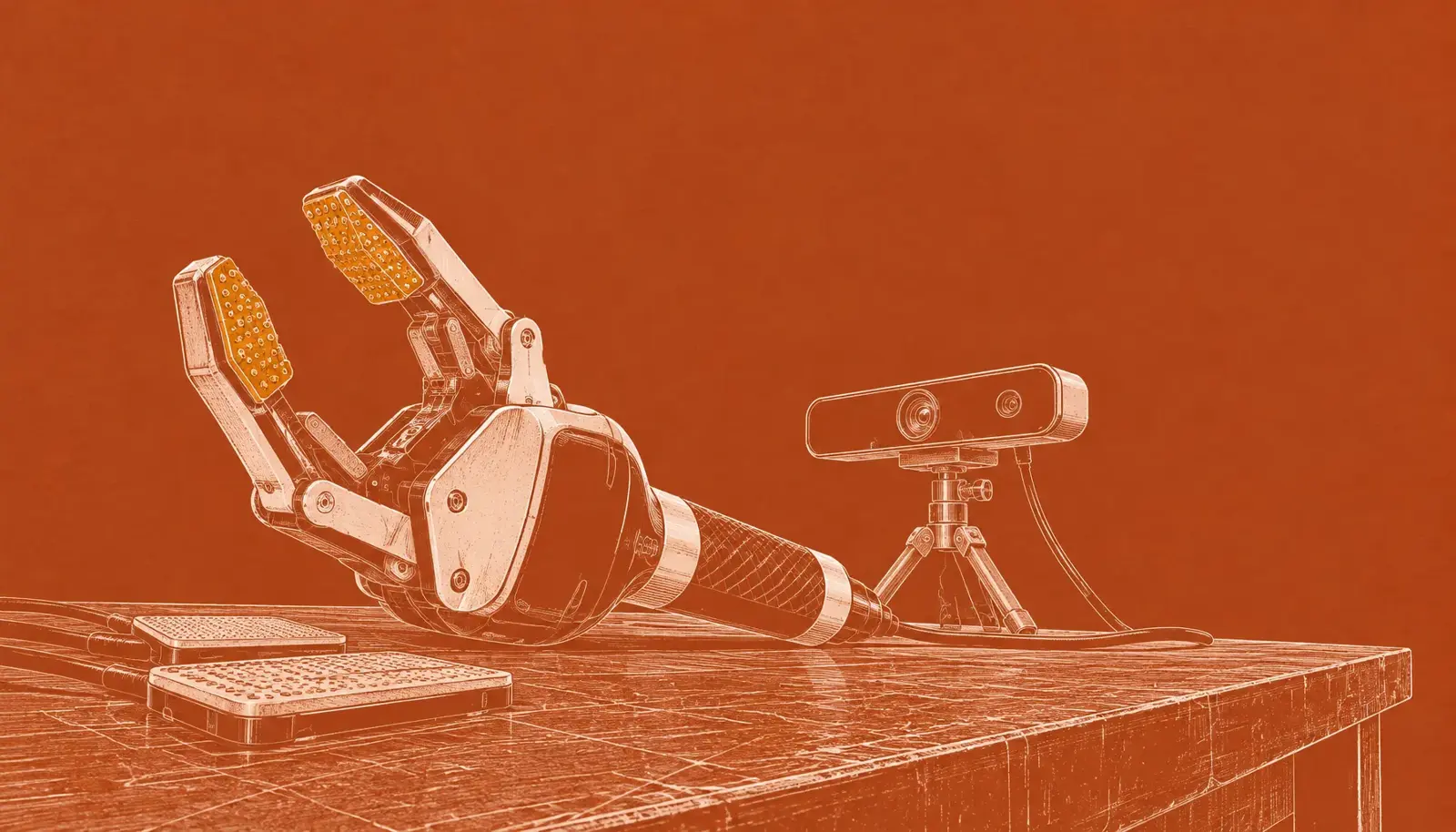
More than a million episodes, recorded with touch
TacClaw-Infinity reports more than 1 million manipulation episodes, 10,000 hours of recordings and 1 billion frames across more than 1,000 task types. The authors posted the paper to arXiv on October 14, describing a dataset that combines visual observations, fingertip tactile signals, language instructions and motion trajectories for contact-rich robot tasks.
The collection spans more than 50 physical locations, including homes, laboratories, industrial workplaces, retail stores and outdoor settings. More than 20 organizations contributed, and the team says it deployed 200 TacClaw devices to support collection across those sites. “Together, these efforts yield over 10,000 hours, 1 million episodes, and 1 billion frames spanning more than 1,000 task types,” the authors write in the paper’s abstract.
“We present TacClaw-Infinity, a large-scale structured Vision-Tactile-Language-Action (VTLA) dataset for contact-rich manipulation, collected with TacClaw, a tactile-enabled UMI-style handheld interface that records synchronized visual observations, fingertip tactile signals, and end-effector trajectories without requiring a target robot during data collection.”
Fucai Zhu et al., “TacClaw-Infinity”
A handheld gripper keeps collection off the robot
TacClaw is a handheld interface modeled on the Universal Manipulation Interface approach: a person demonstrates a task directly, without collecting the demonstration on the robot that may later perform it. The device combines cameras, inertial tracking, a gripper encoder and fingertip visuotactile sensing. Its sensors capture deformation, shear and depth, while the end-effector trajectory records how the tool moves.
The paper says the tactile sensors capture three-axis signals at up to 120 hertz; the visual, tactile and trajectory streams are synchronized at 30 hertz in the recorded episodes. Demonstrations include single-hand and bimanual tasks. Contact events also anchor the authors’ annotation pipeline, which divides recordings into phases such as contact onset, in-contact manipulation and release, then generates descriptions and object-localization masks.
Touch raised success in the authors’ robot tests
The team evaluates policies on three platforms—Tianji, RealMan and DM-Sparky—and three bimanual tasks: cup stacking, bottle sorting and vase wiping. Each task uses 1,600 training episodes and 50 evaluation trials. The authors report that policies trained on TacClaw demonstrations transferred across the three robot embodiments without robot-specific demonstrations.
Across the platforms, adding tactile observations raised the average success rate for the π0.5 policy from 50.0% to 74.0%, and for StarVLA from 46.0% to 72.7%. Gains were concentrated in bottle sorting and vase wiping, tasks where touch helps distinguish an object’s state or regulate sustained contact. The tactile input entered the policies through a simple image-input formulation, rather than a specialized tactile architecture.
Annotation quality still has gaps
The paper’s own checks qualify the dataset’s scale. In a manual review of a random 5% sample of generated subtask descriptions, roughly 83% passed checks for correctly identifying the action and object; the authors say tasks containing failed samples are held for re-annotation, while errors may remain elsewhere. For spatial labels, 98.5% of frames in the specified labeling windows had an object mask, but the authors stress that mask coverage does not establish mask accuracy.
Those caveats matter for teams using the annotations as training targets: a mask can be present without being correct, and sampled review cannot certify every generated description. TacClaw-Infinity’s paper lays out a large collection and cross-robot tests, but its reported results do not remove the need to inspect data quality and validate policies on each intended task and platform.
Sources
- Original source · Preprint TacClaw-Infinity: A Large-Scale Vision-Tactile-Language-Action Dataset for Dexterous Manipulation arXiv:2610.20320