The Floor
UC3M and UPNA Build a Soft Gripper That Turns Objects in Hand
A modular soft robotic gripper developed by researchers at UC3M and UPNA combines tendon-driven bending with rotation at the base of each of its three fingers. The paper reports continuous rotation of an object within the grasp, without releasing it.
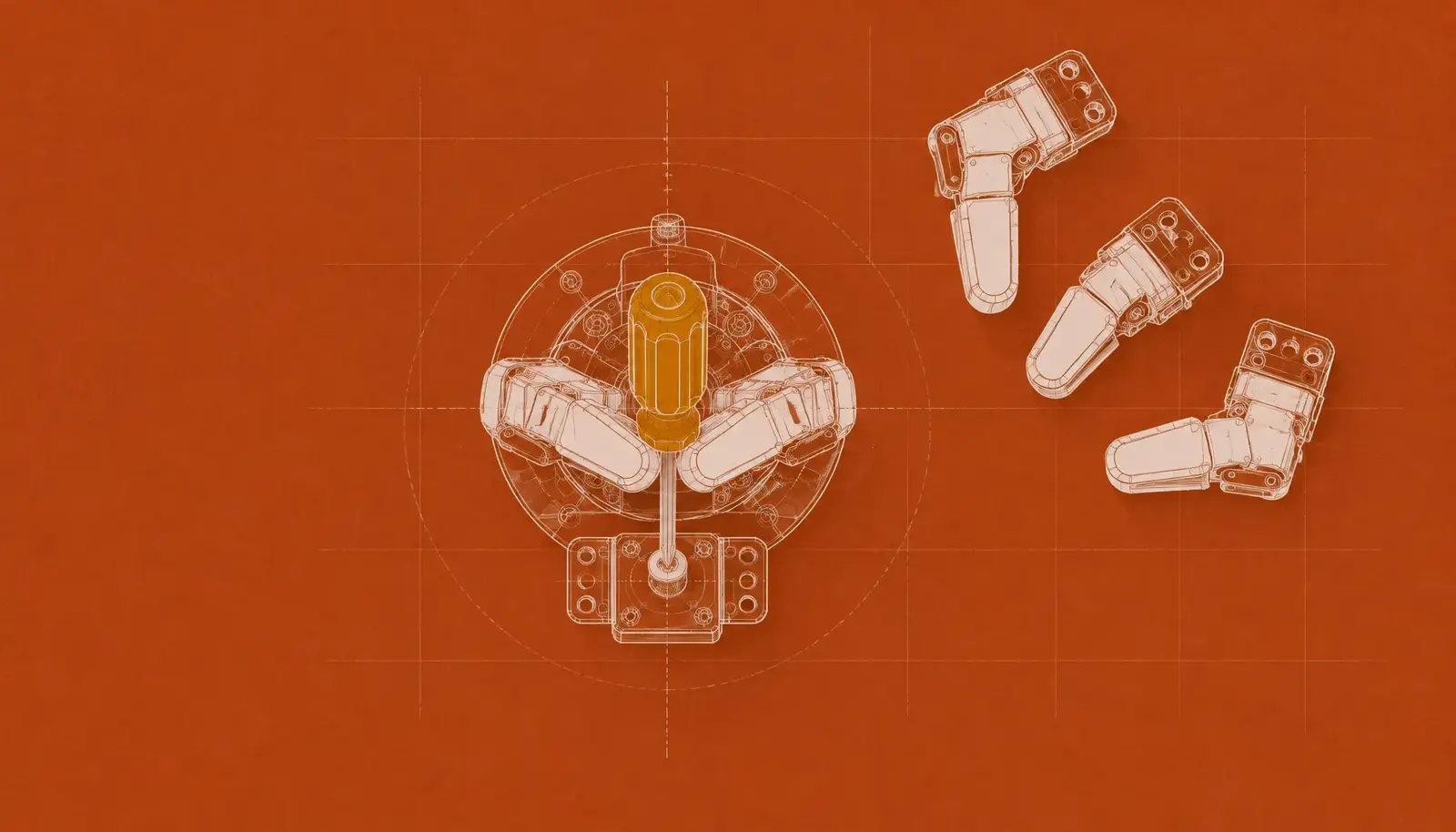
On October 4, Universidad Carlos III de Madrid and the Public University of Navarre described a soft robotic gripper that can reposition an object between its fingers without letting go. Its three independently actuated fingers combine flexible bending with rotation at each finger’s base, allowing the gripper to change an object’s orientation while maintaining contact. The research paper appeared in Bioinspiration & Biomimetics on August 11, 2026.
Source pubmed.ncbi.nlm.nih.gov
Three fingers bend and rotate
Each finger has three degrees of freedom. Tendons drive asymmetric bending in the soft joints, while active rotation at the base adds another movement. Coordinating the fingers’ bending and rotation lets the gripper move an object within its grasp. Continuous rotation along an object’s axis without releasing the initial grasp is reported in the paper’s abstract.
“A core principle of this design is an asymmetric soft joint that exploits passive geometric blocking to provide direction-dependent compliance and mechanical protection against excessive deformation.”
Carlos Relaño, Alberto Rodríguez-Sanz, Lisbeth Mena and Concepción A. Monje, the study’s authors, write.
The joint’s asymmetric geometry gives it different compliance in different directions and helps protect it from excessive deformation. The authors describe the design as modular. In the university-reported account, the three fingers can be assembled and removed separately, so an individual finger can be replaced without changing the entire gripper.
Repositioning without releasing
The paper presents the system as a response to a limitation of conventional tendon-driven soft grippers: they can hold objects, but their available degrees of freedom may not be sufficient for dexterous reorientation. Some approaches instead rely on hybrid mechanisms or repeatedly releasing and grasping an object. This gripper combines tendon-driven bending with active rotation at the finger bases to move an object while retaining the initial grasp.
The university account describes examples of objects used to demonstrate the gripper, including a water bottle, a cube, a tissue package, a fidget spinner, a 3D-printed figurine, a rubber duck, stuffed toys, a screwdriver and an artificial rose. The published abstract characterizes the tested objects more broadly, saying experimental validation showed the system could grasp objects spanning a wide range of sizes and stiffnesses using a unified actuation strategy. It does not give a trial count or a numerical success rate in the abstract.
The study also reports continuous object rotation along its axis without releasing the initial grasp. That result concerns in-hand manipulation: changing how an already-held object is oriented. The abstract does not establish an end-to-end pick-and-place rate or quantify performance in a production line or home setting.
Possible uses and open questions
The university account points to possible uses in which a robot needs to adjust its hold without setting an object down and picking it up again, such as orienting a part before assembly or handling fragile and irregular items. It also mentions food processing, logistics, laboratory settings and collaborative or assistive robotics as potential areas of relevance. These are proposed applications, not results demonstrated by the abstract.
The research describes a modular soft-gripper architecture intended to combine compliant grasping with active, continuous manipulation. Its reported contribution is the coordinated use of asymmetric tendon-driven bending and base rotation across three fingers. The paper’s abstract reports grasping objects of varied sizes and stiffnesses and rotating an object along its axis without releasing it; it does not provide the detailed trial figures or test conditions described elsewhere.
Sources
- Original source · Paper PubMed pubmed.ncbi.nlm.nih.gov
Other pages read
- Bioinspiration & Biomimetics / IOP Publishing doi.org
- Tech Xplore techxplore.com