The Floor
Unitree G1 Catches Nine Unseen Objects With One Camera
A seated Unitree G1 caught nine objects unseen during training using one egocentric camera, with success rates of 38.9% for underhand tosses and 36.1% for overhand tosses. The researchers trained the catching policies in simulation and tested them on a dexterous hand attached to the robot.
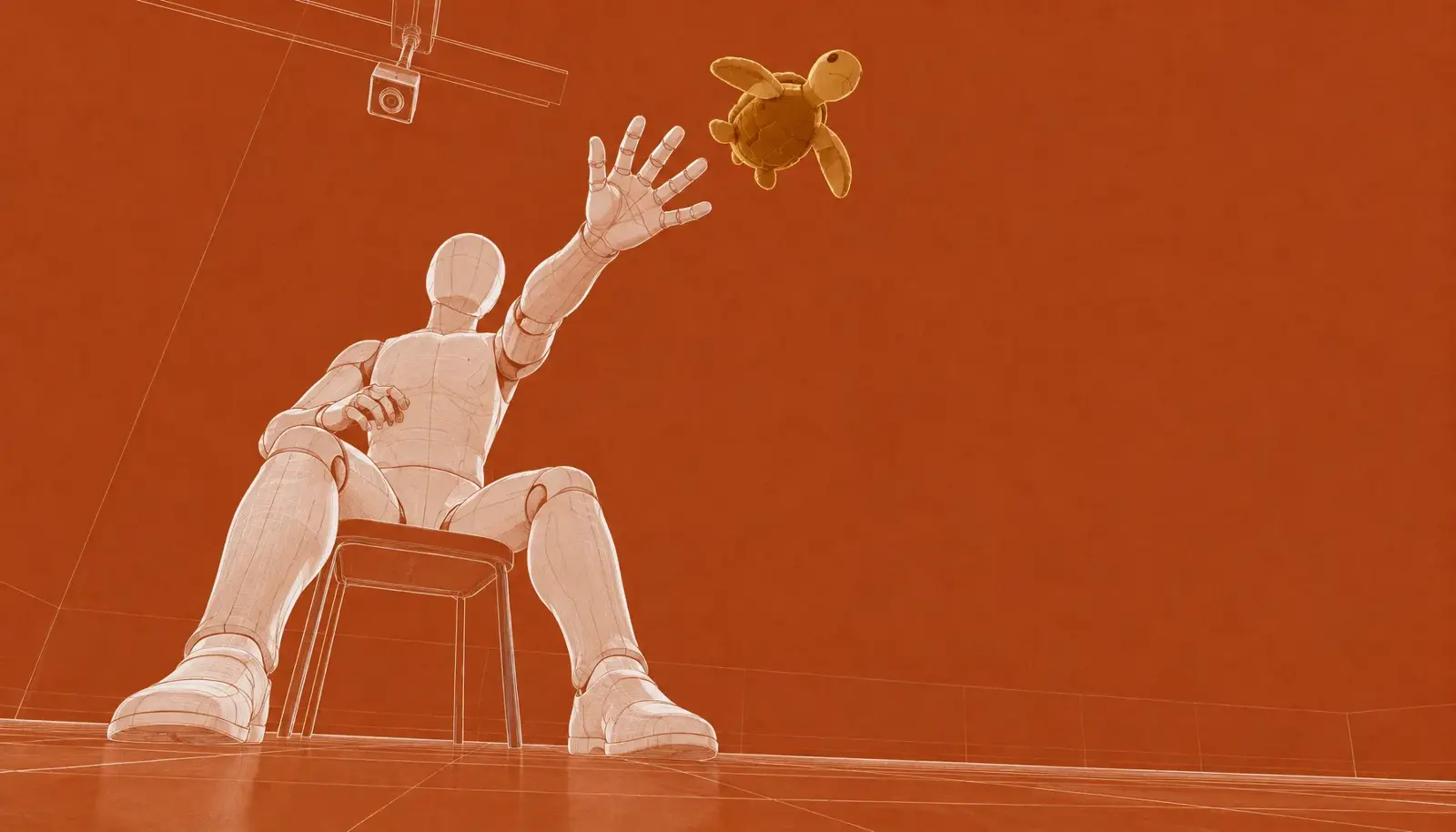
One camera, nine objects, fewer than four catches in ten
A seated Unitree G1 caught previously unseen objects with a single egocentric camera, but the physical test success rates were 38.9% for underhand tosses and 36.1% for overhand tosses. The results come from “Catch It All!: Generalizable Dynamic Catching with a Dexterous Hand,” a paper submitted to arXiv on October 28 by researchers from UC San Diego and Harvey Mudd College. The team tested nine objects that did not appear in training, spanning plush, deformable and rigid-elastic items.
Each object received four tosses per catching style: one short, two medium and one long. The researchers report the long tosses exceeded 1.8 meters; the medium tosses ranged from 1.4 to 1.8 meters, and the short tosses from 1.0 to 1.4 meters. The reported percentages correspond to 36 attempts per style, making the results an early demonstration rather than evidence of reliable catching in routine use.
A G1 EDU sits while its hand tracks the toss
The setup used a seated Unitree G1 EDU fitted with a 20-degree-of-freedom House of Dextra hand and a ZED2i camera mounted overhead to capture the robot’s egocentric view. A person threw objects toward the robot, which used the camera-derived object position and dimensions, along with its own body-state measurements, to move its arm and shape its grasp. The paper describes the camera as the system’s only camera; it does not use motion capture or human demonstrations to train the catching policy.
The test set covered three types of object dynamics. Plush examples included a panda, turtle and sandbag; deformable objects included a Takis snack, strawberry and pineapple; and the rigid-elastic group included a green bowl, an ellipsoid and a bear. Those differences matter at contact: soft items compress, while harder objects can rebound away from the hand.
Simulation teaches a policy to correct its view
Training began in Isaac Gym with seven primitive object shapes, while simulation testing added irregular and long-axis shapes the policy had not seen. The system uses a teacher-student process: a reinforcement-learning teacher learns with ground-truth object positions, then a student learns from noisier camera observations through DAgger imitation. The student uses a 50-step history, which the authors describe as one second of observations.
A key design choice is how training rewards the hand for approaching an object. Instead of relying only on palm distance or requiring particular fingers to make contact, the researchers reward the distance from the fingertips to the object’s surface. In their MuJoCo transfer tests, the teacher reached 81.6% success for underhand catches and 22.1% for overhand catches; the camera-observation student reached 56.3% and 37.0%, respectively. Those are simulation results, not the physical G1’s success rates.
The paper’s authors—Arth Shukla, Kehlani Fay, Huaze Liu, Darin Djapri, Alexiy Buynitsky and Nicklas Hansen—write:
With only one egocentric camera, Catch It All! successfully performs underhand and overhand catches on 9 unseen objects not seen during training, including low-rebound plushes, semi-deformable toys and chip bags, and rigid-elastic objects with high rebound on contact.
Arth Shukla, Kehlani Fay, Huaze Liu, Darin Djapri, Alexiy Buynitsky and Nicklas Hansen, authors of “Catch It All!: Generalizable Dynamic Catching with a Dexterous Hand”
The tests stop at a seated arm
The authors identify a limit in the simulated tests: performance fell by about 20% on long-axis objects, whose high angular velocity was not captured by the system’s state representation. The real-world evaluation also involved a small set of nine objects and four tosses per object for each catch style, so the paper does not establish how the approach performs across larger object collections or repeated everyday use.
The setup tests arm-and-hand catching, not whole-body movement. The authors say they have not applied the framework to whole-body control, leaving unanswered whether a humanoid can combine catching with walking, repositioning or recovery after a missed toss. For now, the reported physical result is 14 successful underhand catches and 13 successful overhand catches across the 36 attempts in each group.
Sources
- Original source · Preprint arXiv arXiv:2610.39044
Related stories
- WholeBodyMem Lifts Unitree G1 Memory-Task Success to 88.3%
- LEAP Hand State Policy Reaches 95.2% of Unseen Pose Goals
- Zero-HLM Simulation Training Beats Real Data in G1 Trials
- Machenta Raises $40M to Teach Robots From One Demonstration
- PyRUA-DataFarm policies scored 93 to 84 in the original scene, 87 to 46 under unseen appearance