The Floor
CMU Builds a $90 Fingertip That Feels Force and Vibration
Carnegie Mellon researchers developed a low-cost robotic fingertip that combines force sensing with vibration sensing to help a hand handle delicate objects and detect contact details. The team tested it on fragile-object grasping, cup counting and unstacking, and identifying materials inside visually identical boxes.
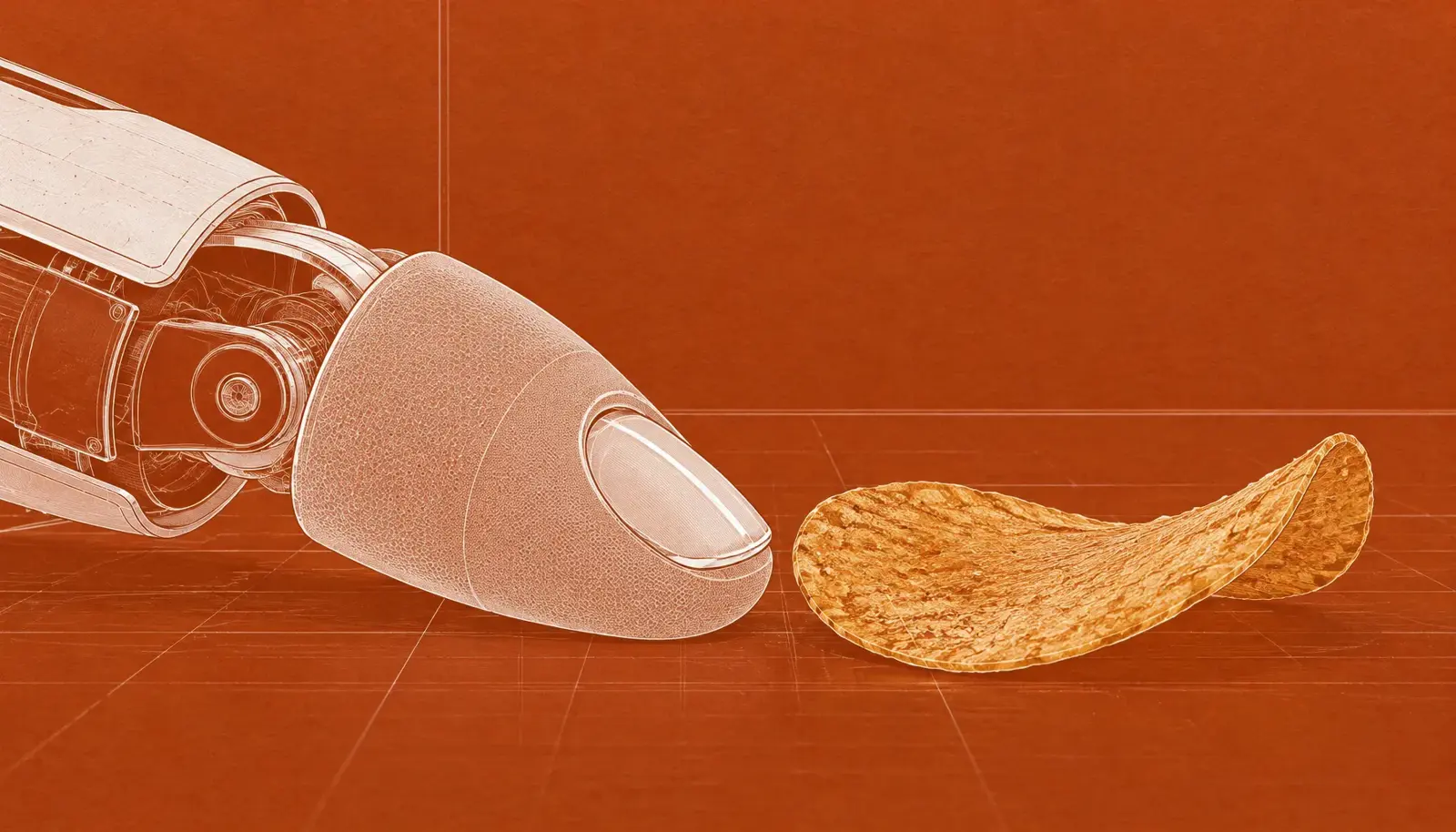
Carnegie Mellon researchers tested a low-cost robotic fingertip on delicate objects, including tofu cubes and potato chips. The fingertip combines force sensing with vibration sensing, giving a robotic hand information about how hard it is squeezing and what it encounters as it slides across an object. Carnegie Mellon’s Robotics Institute described the work on October 5, 2026, after the team presented it at the 2026 Intelligent Robots and Systems Conference in Pittsburgh.
Source arxiv.org
A $90.34 bill of materials
The project page lists a bill of materials costing $90.34 per fingertip. It includes an Arduino Uno, a sound card, four strain gauges, a contact microphone, circuit boards, cabling and 3D-printing and skin materials. The fingertip cost less than $100, compared with $800 to create a similar device from off-the-shelf products, Carnegie Mellon says.
The fingertip has a rigid internal structure and a plastic cap with a fingernail, covered by a soft skin for grip. Strain gauges measure contact forces, while a contact microphone beneath the nail picks up high-frequency vibrations when the nail slides over an object or bumps into a surface. The project’s fabrication description lists steps including attaching the microphone to the 3D-printed cap, mounting circuit boards and applying foam and grip tape.
Force and vibration for different tasks
Force readings let the hand regulate how tightly it grasps an object. Vibration signals can help detect slipping, textures and edges, including contact details that may be hidden from a camera by the hand itself. The paper reports repeatable three-dimensional force measurements in the 0–5-newton range and describes vibrotactile signals associated with different material types.
The four authors listed on the paper are Zhuowei Xu, Zilin Si, Oliver Kroemer and Zeynep Temel. They write:
“We evaluate our design with three types of manipulation tasks, including slip-aware closed-loop grasping to handle a wide range of objects, cup counting and unstacking with precise contact localization, and box selection and opening with hidden material identification.”
For fragile-object grasping, the researchers used force control to close the hand and vibration signals to detect slips and adjust grasp strength. Tests used objects such as tofu cubes and potato chips, Carnegie Mellon reports. The project page says the adaptive-grasping evaluation used a test set of 10 objects with different shapes, weights and stiffnesses, and reports an overall success rate of 96%.
Counting cups and identifying hidden contents
In the cup task, the fingertip’s nail slides along a stack’s edge while the robot uses vibration signals to detect cup edges. The project describes combining those detections with finger-position and force readings to localize the cups and unstack them. The task was used to assess manipulation when the robot’s view was blocked, Carnegie Mellon says; the supplied project description does not give a trial count or a numerical comparison with vision.
The team also tested boxes that looked alike but contained different materials, including screws, rubber bands or a mixture. The robot grasped and lifted each box, then shook it while recording force and vibration signals. It used the resulting material prediction to choose a box and open it. The paper describes this as hidden-material identification; the project page illustrates the setup and classification results but does not establish a general success rate for arbitrary boxes or contents.
Carnegie Mellon associate professor Oliver Kroemer said the work addresses the difficulty of fine manipulation: “However, fine manipulation is still very much an open challenge, and that’s why we wanted to focus on it.” The research builds on the team’s DeltaHands device. The researchers plan to explore expanding sensing from the fingertips to the rest of the robotic hand, Carnegie Mellon says.
Sources
- Original source · Preprint A multi-modal tactile fingertip design for robotic hands to enhance dexterous manipulation arXiv:2510.05382
Other pages read
- Carnegie Mellon University Robotics Institute ri.cmu.edu
- TactileFingertip project website sites.google.com