The Floor
Rhoda Adds Tactile Signals to Its Robot Policy
Rhoda AI introduced a tactile sensor and a multimodal Direct Video-Action model on October 13, 2026. In a camera-blocked demonstration, the robot used touch to find and retrieve textured balls from a box.
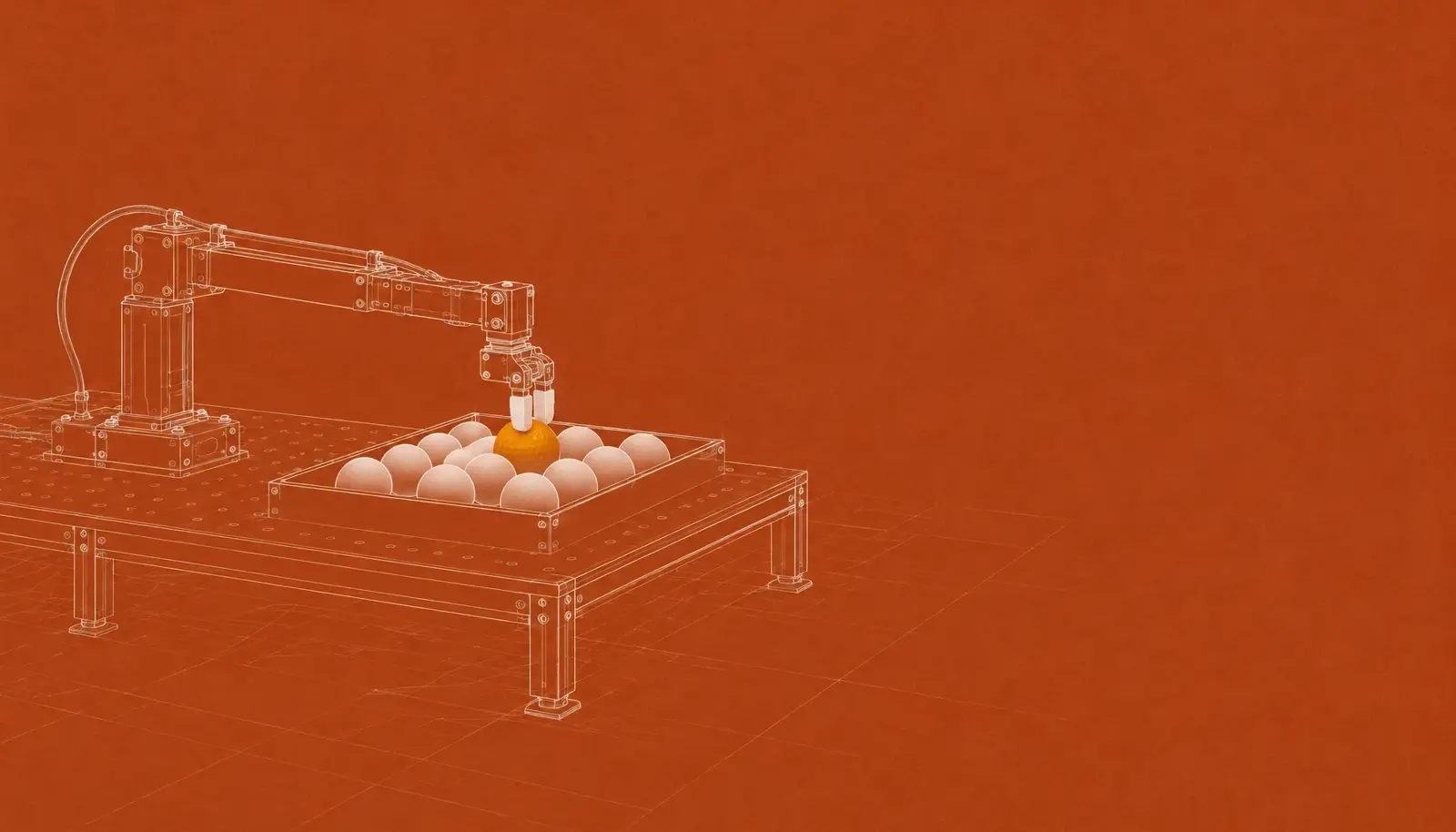
Rhoda AI’s October 13 demonstration blocks a robot’s head and wrist cameras, then asks it to find textured balls by touch. The company says its new tactile sensor and modified Direct Video-Action (DVA) policy let the robot search, distinguish textures and retrieve objects without vision. The result tackles two linked problems: capturing contact precisely and turning those measurements into useful robot actions.
Camera-blocked tests put touch in control
Rhoda first trained the model with one smooth ball and one textured ball in a box. In a second test, the same model searched among four smooth balls and three textured ones, including two textured balls with differences in diameter, firmness and texture from the training example. Rhoda says the robot identified and retrieved all the textured balls in an extended autonomous run.
The company describes the demonstration as a test of more than contact detection. The robot must feel around, distinguish the balls through their surface properties and adjust its gripper to secure a grasp. Rhoda shows the robot completing those steps with its cameras blocked, but does not report a trial count or a success rate.
DVA predicts touch before translating it into action
Rhoda’s policy predicts future tactile signals, then uses an inverse-dynamics model to convert those predictions into robot actions. New tactile measurements feed back into the next prediction as the robot moves. “Our multimodal DVA model additionally takes a history of tactile videos as input and generates future tactile videos,” writes the Rhoda AI Team.
The approach extends the company’s earlier DVA model, which treats predicted video as a guide for robot behavior and translates predictions into actions. Adding tactile observations gives that policy another stream of feedback when a camera view is blocked or conditions make vision unreliable. The demonstration tests that arrangement in a constrained ball-retrieval task, rather than establishing performance across a broad range of objects or settings.
The sensor spans light contact to heavy loads
Rhoda packages its sensor for a robot gripper and reports that it detects forces from a few millinewtons, measured in a feather-brushing test, to more than 40 newtons in a heavy-load test. The company also demonstrates normal and shear-force sensing, and samples contact-induced vibrations at approximately 500 hertz. Separate demonstrations show the sensor detecting a wrist pulse and recording temperature changes during contact with warm water and ice.
In the feather test, Rhoda says the optical and magnetic sensors it tested showed no distinguishable response under the same conditions. The post does not identify those comparison sensors by model or report a standardized benchmark. Rhoda describes its design as compact and low-cost, but gives no price or availability information.
Contact data also enters human demonstrations
Rhoda fits the sensors into the fingers of a handheld Universal Manipulation Interface, which records people demonstrating manipulation tasks. The company says the setup captures normal and shear forces alongside video and motion, preserving information about how firmly a person grasps an object and changes contact during handling. Standard UMI demonstrations capture visual information and motion but, Rhoda says, omit those contact forces.
The tests show one way to connect tactile hardware, recorded demonstrations and a policy that predicts future touch. Rhoda’s next concrete evidence will need to show how the system performs beyond the ball task, with repeatable trial results and comparisons against policies that do not use tactile input.
Sources
- Original source Rhoda AI Research · Giving robots a sense of touch rhoda.ai
Other pages read