The Floor
UC San Diego Team Open-Sources a Modular Continuum-Robot Drive
UC San Diego researchers published an open-source actuation platform for tendon-driven and concentric-tube continuum robots. Bench tests measured 0.29 mm average maximum accumulated translation error, and teleoperated demonstrations paired the drive with the da Vinci Research Kit.
A 0.29 mm error in the translation test
A modular drive system from University of California, San Diego researchers recorded an average maximum accumulated translation error of 0.29 millimeters in its characterization test, while rotating the instrument through 180 degrees produced an average maximum error of 4.89 degrees. The results, reported in a paper submitted to arXiv on October 14, accompany an open release of the system’s hardware designs and ROS-based control software.
The platform aims to let researchers reuse an actuation system across different continuum robots instead of building a new drive for each instrument design. Yunti Xu, Aedan Mangan, Miheer Potdar, Alex Lu and Tania K. Morimoto describe a system built from stackable modules that provide linear translation and axial rotation, with software that connects motor control to higher-level robot programs.
“All hardware designs and ROS-based software are open-sourced to facilitate reuse and further research in continuum and surgical robotics.”
Yunti Xu, Aedan Mangan, Miheer Potdar, Alex Lu and Tania K. Morimoto
One drive for tendons and nested tubes
Continuum robots bend along their bodies to work through narrow or obstructed spaces. The paper focuses on two types: tendon-driven robots, whose bending depends on pulling tendons, and concentric-tube robots, which steer through relative movement of nested, pre-curved tubes. Their different drive requirements have often led research groups to build specialized mechanisms that are difficult to transfer between designs.
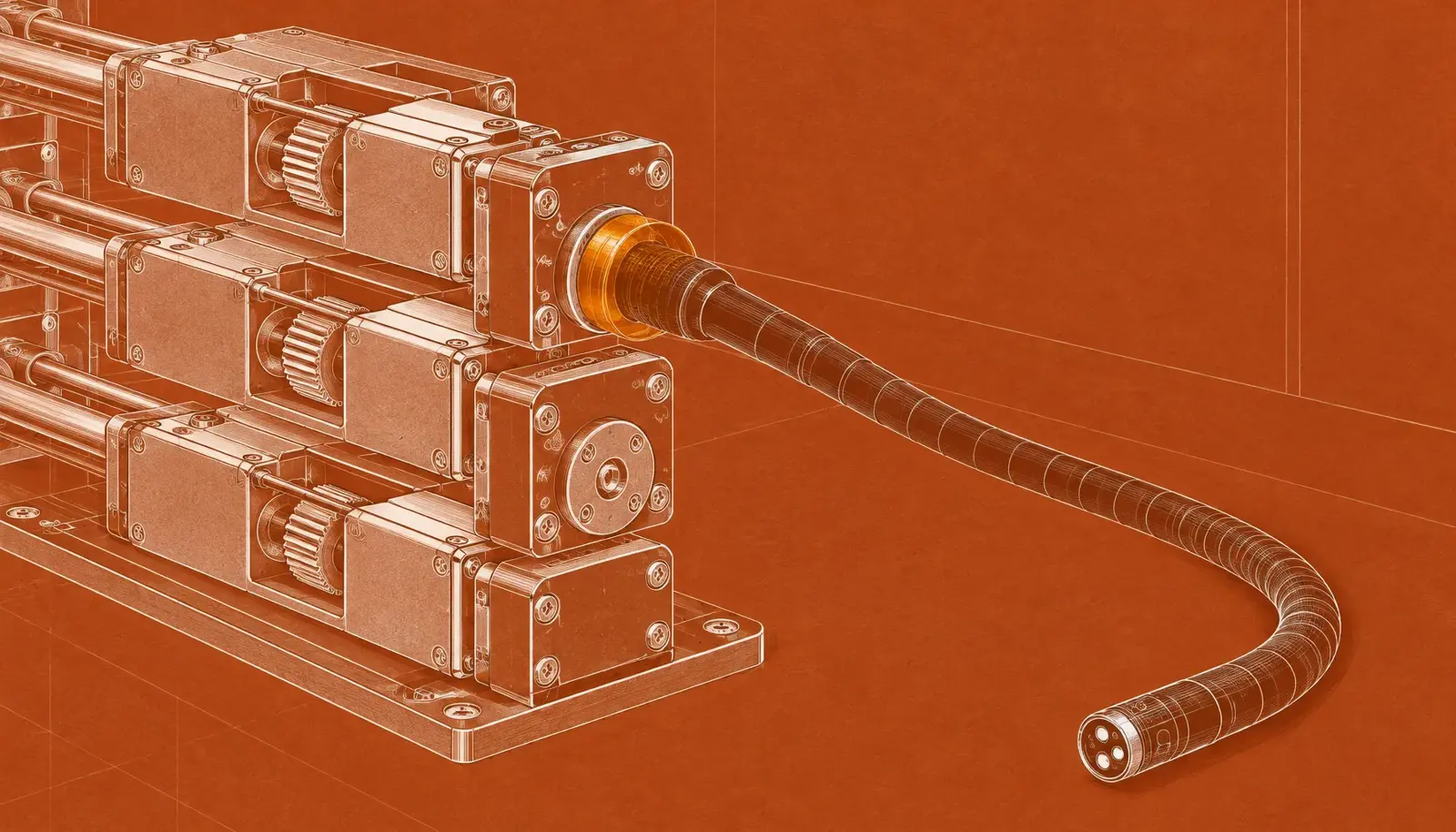
In the UC San Diego design, modules slide along rails using a lead screw, while a worm-gear mechanism rotates the instrument shaft. A hollow central channel leaves room for a camera or tool. Users can add modules to accommodate a robot’s degrees of freedom, and the control software represents each motor as a configurable unit; a ROS 2 interface provides a path to other robot systems.
The researchers mounted the platform on the patient-side manipulator of the da Vinci Research Kit, an open research system. Their assembly attaches with a quick-release mechanism, and the paper says tool-free attachment and removal take less than a minute. The complete three-module concentric-tube setup weighs 1,561 grams; the five-module tendon-driven setup weighs 1,328 grams.
Bench tests and teleoperated tasks
For the accuracy measurements, the team commanded translation and rotation in increments at 1 hertz, then measured motion over a total of 30 millimeters and 180 degrees across three trials. The largest errors occurred when the drive reversed direction, where mechanical backlash was greatest. The authors describe the translation result as sub-millimeter accuracy under open-loop control; it is a characterization of the drive module, not a clinical performance result.
The team also demonstrated a six-degree-of-freedom continuum camera navigating around obstacles and a miniature forceps performing a peg-transfer task alongside a conventional wristed instrument. The forceps’ outer diameter was 2.53 millimeters. In the demonstration, it picked up a rubber band, handed it to the wristed instrument and placed it on another peg about six centimeters away.
Both surgical examples used teleoperation on the research platform. The paper does not report clinical testing. It identifies integrated sensing, improved teleoperation mappings and redundancy resolution as future work, including development toward “follow-the-leader” motion. Whether the open hardware can retain its measured accuracy across different instruments, loads and operating conditions is not answered by these demonstrations.
Sources
- Original source · Preprint Design and Characterization of a Unified Continuum Robot Actuation Platform arXiv:2610.19798