The Floor
Tiny Robot Resumes Flight After Compression Under 11,000× Its Weight
A 185-milligram, all-polymer flying robot resumed flight after being struck by a flyswatter or flattened under loads approximately 11,000 times its own weight. The prototype can take off and climb, but it still depends on external wires for power and lacks the systems needed for controlled, self-contained flight.
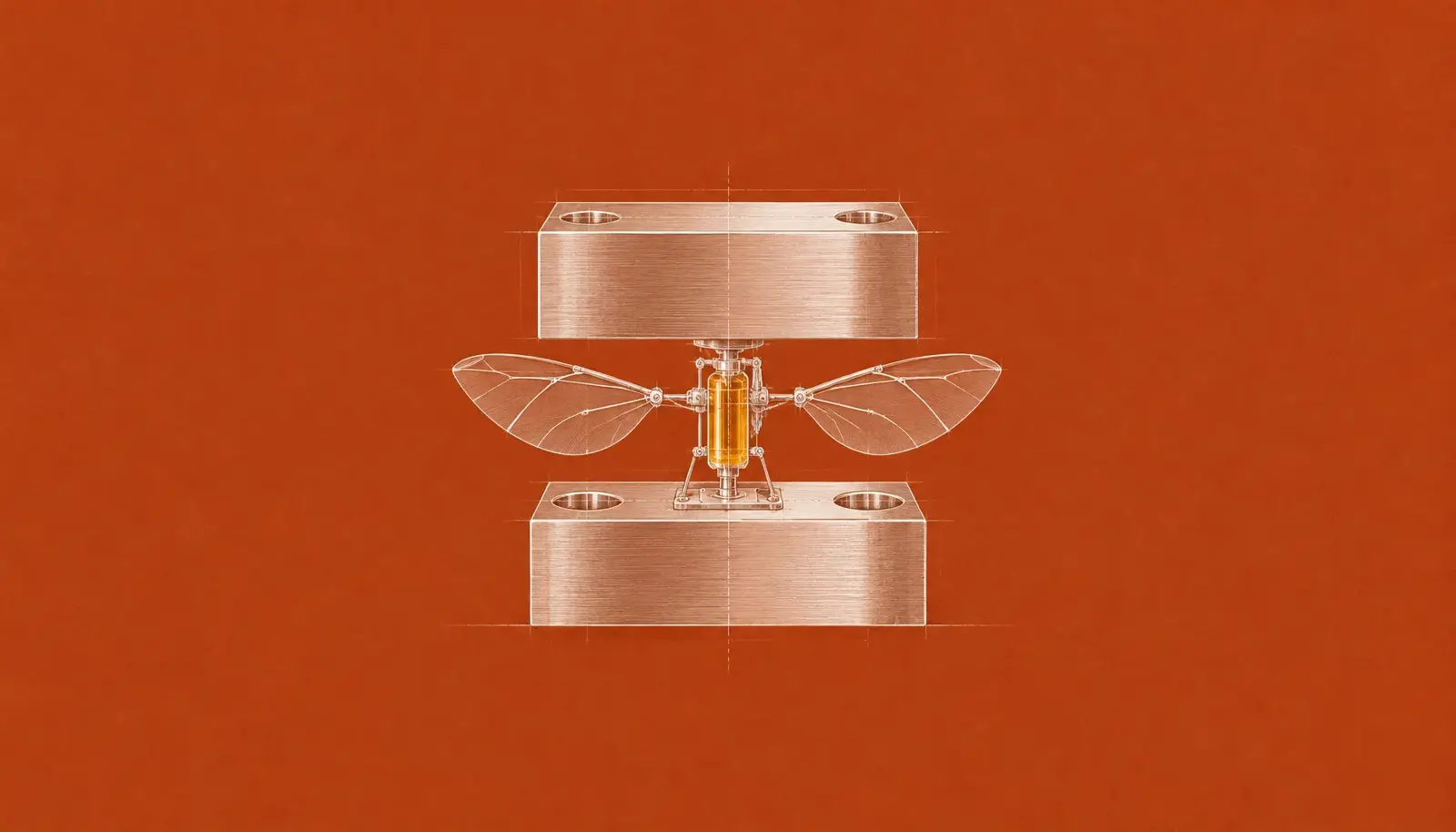
A 185-milligram flying robot built from polymers resumed flight after being hit with a flyswatter and after being flattened under loads approximately 11,000 times its own weight. The result does not mean the machine flies while carrying that load: it demonstrates recovery after compression. Researchers from UCLA, UC Davis and MIT reported the prototype in Science Robotics.
Source pubmed.ncbi.nlm.nih.gov
The robot took off without assistance and ascended at an average speed of 40 centimeters per second. Its flexible wings and actuator are designed to bend under contact, rather than depending on a separate mechanical transmission to transfer motion to the wings. The work tests whether a small flapping-wing machine can withstand impacts and compression while still generating enough lift to take off.
A flexible design for takeoff
The prototype weighs 185 milligrams and is made entirely from polymers. An electrostrictive bending actuator drives its cone-shaped, compliant wings directly. When voltage switches on and off, the actuator bends rapidly and produces the flapping motion. The wings partially deform during each beat, helping generate upward lift while allowing them to yield under pressure.
“We report a resilient all-polymer flying robot weighing 185 milligrams, powered by an electrostrictive bending actuator that directly drives cone-shaped compliant wings without a transmission.”
The authors of the Science Robotics paper write
The paper reports an actuator power density of 1,600 watts per kilogram and a bending angle of 136 degrees at 110 hertz. At 30 hertz, the robot reached a lift-to-weight ratio of 3.0 and a lift-to-power ratio of 8.3 millinewtons per watt. These measurements describe different operating conditions: the bending angle was measured at 110 hertz, while the lift ratios were reported at 30 hertz.
Recovery after contact
In tests described by UC Davis, the prototype was directed into an obstacle, struck with a flyswatter and flattened by aluminum blocks weighing 11,000 times its own weight. It recovered in each instance. The results show recovery after those specific tests; they do not establish that the robot is ready to operate independently in an outdoor environment.
The wings’ flexibility is central to the design. Rather than relying on rigid components that may break on impact, the wing structure deforms under pressure and returns to a working shape. The authors’ measurements also show that the actuator and wing arrangement generated enough lift for unaided takeoff. Together, the tests demonstrate a small flying machine that can recover from several forms of contact while retaining its ability to fly.
The prototype remains a laboratory system. It receives electrical power through external wires, and the current version does not have onboard power or the control systems and sensors needed for self-contained flight. UC Davis reports that next steps include improving flight control, including turning and landing, and increasing the payload the machine can carry.
What remains to be demonstrated
The study’s results concern takeoff and recovery, not a complete mission in a natural or hazardous setting. Environmental monitoring, pollination and search and rescue are possible areas of future application, but the robot would first need onboard power, control and sensing. Its ability to resume flight after impacts is one capability toward that goal; steering, landing and carrying equipment remain additional challenges.
Sources
- Original source · Paper National Library of Medicine (PubMed) pubmed.ncbi.nlm.nih.gov
Other pages read
- UC Davis College of Engineering engineering.ucdavis.edu
Related stories
- UCLA’s PhoneBot Uses Android Phones to Control a Walking Humanoid
- Soft hexapod reaches 4.72 m/s using pneumatic control
- ETH Zurich Co-Designs Living Muscles for Jumping Robots
- Oxford researchers report agent-designed soft robots in preprint
- SUSTech Team Builds Humanoid Skin With More Than 10,000 Sensors