The Floor
UMI-Live Releases a $1,930 Bimanual Data-Collection Rig
UMI-Live pairs two sensor-equipped handheld grippers with software for recording and processing bimanual robot demonstrations. Its authors released the designs, code and a 39.7-hour dataset, then tested policies on a six-orange pick-and-place task.
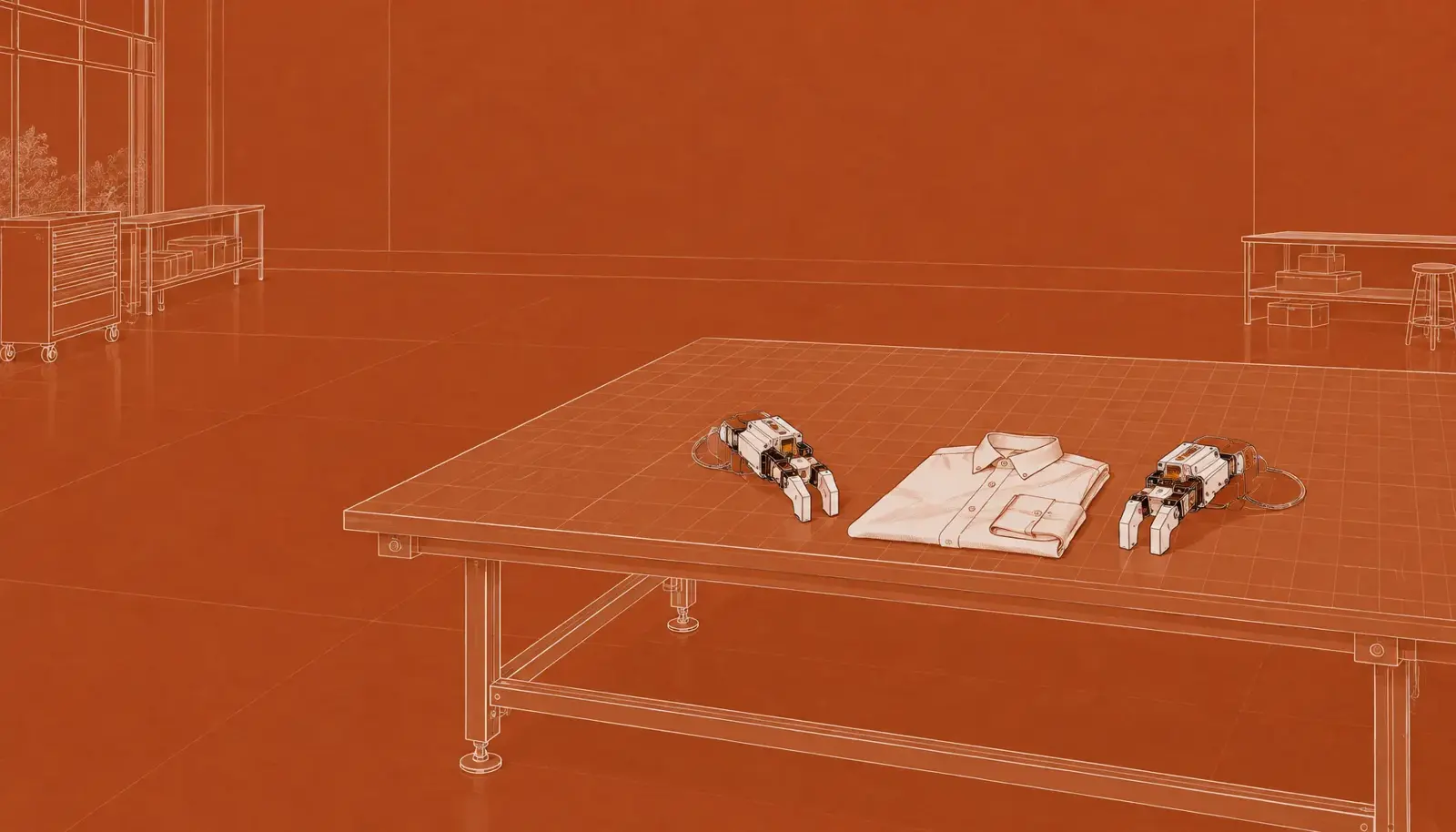
A pair of UMI-Live data-collection grippers costs $1,930 in the evaluated hardware revision, according to a paper posted October 29. The open-source system records two-handed demonstrations without requiring a robot at the collection site, then processes them into datasets for robot learning. Its authors also released about 39.7 hours of demonstrations across three tasks.
Two instrumented grippers, no tracking stations
Each handheld unit carries a wide-angle wrist camera, a LiDAR sensor with an integrated inertial measurement unit, a Raspberry Pi 5 and a removable battery. The camera records 800-by-600-pixel video at 30 frames per second. Each unit weighs 1.42 kilograms with its battery, opens to 80 millimeters and runs for a reported 1.5 hours per charge.
Operators start and stop both devices with one button. The design avoids external tracking equipment and calibration specific to the room where demonstrations are recorded, but it is not calibration-free: the authors say the cameras and grippers require one-time calibration. They also note that LiDAR-inertial reconstruction depends on the geometry of the scene and how the operator moves the devices.
“We present UMI-Live, a full-stack open-source bimanual UMI system for in-the-wild data collection.”
Govind Velamoor et al., “UMI-Live for In-The-Wild Bimanual Robotics Data Collection”
Recording continues while the server builds episodes
During a demonstration, each gripper saves timestamped video, LiDAR and inertial data locally. After recording, a server checks synchronization, reconstructs each gripper’s trajectory with LiDAR-inertial SLAM, estimates jaw opening and aligns the streams into bimanual episodes. Processing runs asynchronously, so an operator can continue collecting while completed recordings move through the pipeline.
The resulting data uses the LeRobot format and pairs wrist images with hand poses, gripper states and task instructions. The paper says the released dataset contains 3,255 episodes, totaling approximately 39.7 hours at 30 frames per second. Its three dataset tasks are orange placement, water pouring and towel folding; the paper separately shows human-operated demonstrations of small-object insertion, lighting a match and folding a shirt.
Mixed demonstrations produced the reported robot results
The team tested the data by fine-tuning π0.5 and MolmoAct2 for a physical task: moving six oranges into a bowl with two i2RT YAM arms. π0.5 completed nine of ten trials when training data combined 95% UMI demonstrations with 5% robot teleoperation, and ten of ten with a 90%/10% mix. Fine-tuned MolmoAct2 completed eight of ten trials with a 75% UMI and 25% teleoperation mix; its released checkpoint completed none.
Those results show policies trained on mixtures dominated by UMI-Live data can perform the tested task, but they do not isolate the handheld data’s contribution. Each condition used one training seed, the evaluation covered one task, and the authors did not compare UMI-only training against teleoperation-only training. The strongest reported result is ten successful orange placements in ten trials, after fine-tuning on a 90% UMI-Live and 10% teleoperation mixture.
Sources
- Original source · Preprint UMI-Live for In-The-Wild Bimanual Robotics Data Collection arXiv:2610.39385